


App Development Cost by Country in 2027: USA vs UK vs India
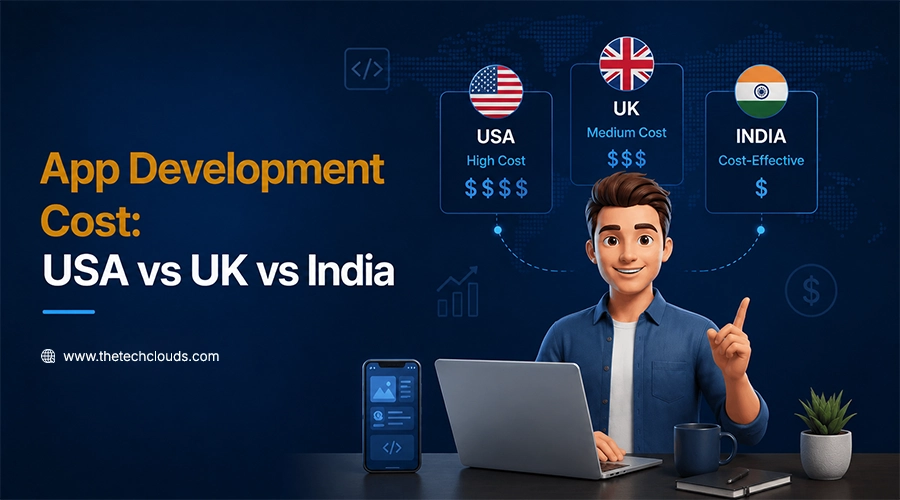
You may want a web app or mobile app with almost the same features, but you’re still getting three different quotes from three different agencies in three different countries. App development cost varies from country to country, and it genuinely swings by tens of thousands of dollars depending on where your team sits, whether that’s Mumbai, Manchester, or Manhattan. Same app, same features, but a completely different invoice just because of their location. But is the price difference only due to location, or something else?
If you really want to know this vividly, then dive a little deeper to find what’s really driving the gap in 2027.
Key Takeaways
- App development cost depends far more on ten stacked factors- team rate, complexity, platforms, and more- than on country alone.
- India offers the strongest cost advantage globally, often 60-70% cheaper than the US or UK for comparable quality.
- Cross-platform and hybrid builds cut costs by 30-40% compared to native, without sacrificing much for most business apps.
- Web apps tend to cost less than mobile apps and come with a real SEO advantage native apps simply don’t have.
- Budget beyond launch day: post-launch maintenance alone typically runs 15-25% of your original build cost every single year.
What Factors Actually Drive Up The Price?
Location or country is just one part of the answer. This can’t be the only reason driving the cost. The real answer sits in ten separate cost drivers that stack on top of each other, with one manipulating the other:
1. Developer and Team Rates
Hourly rates differ by country. For example, the U.S. Bureau of Labor Statistics reported median annual pay of $148,100 for software developers in May 2025, while the UK’s Office for National Statistics reported median full-time annual earnings of £39,039 across all occupations in April 2025.
Similarly, office costs, operating expenses, taxes, and local market conditions are higher than income in India. This is where you can understand what creates the gap between India, the UK, and the US.
2. App Complexity
If you just need a basic informational app or a feature-heavy marketplace, they aren’t remotely the same development job. So the price will differ.
But if you need applications with user accounts, payment gateways, real-time tracking, chat, AI features, dashboards, subscriptions, third-party integrations, and complex workflows, development hours- and therefore the final invoice—increase.
3. Number of Platforms
What to choose between PWAs vs. Native vs. Hybrid vs. Cross-platform is a question many business owners ask when they want something great for mobile apps.
But this is so basic that building separately for Android and iOS would cost more than building a cross-platform app. Moreover, the cost increases if you need web, tablet, smartwatch, or desktop versions; then the price expands further.
4. UI/UX Design Requirements
UX is difficult to ignore in 2026. Custom, brand-heavy design takes longer.
You may also need high speed, animations, complicated designs, mobile-responsive layouts, and multiple user journeys. Each of these requirements can add design and development hours, which further increases app development cost.
5. Technology and Architecture
A trusted team will choose the best technologies for web application development in 2027, and the technology stack can affect both development cost and time.
Mostly, when you need top-grade features like AI, blockchain, AR/VR, advanced cloud infrastructure, or complex real-time systems, prices can go sky-high. This isn’t because of the location; it is because of the features you want included in your app.
6. Integrations and APIs
Obviously, you want to build an app that can integrate with all your present apps. That means the more integrations you add, the more you’ll pay.
Payment systems, CRMs, maps, shipping providers, social logins, analytics platforms, ERP systems, communication services, and third-party APIs can increase the project’s technical complexity.
7. Security and Compliance
Banking, financial, healthcare, and fintech applications store large amounts of personal information and client data. So they need to operate under GDPR and require stronger security controls.
Moreover, frequent audits and automatic updates are mandatory in these applications to avoid breaches. To maintain this, the team must focus heavily on penetration testing and regulatory compliance, which ultimately increases the price.
8. Testing and Quality Assurance
Testing isn’t simply a final step. Applications need functional, usability, compatibility, performance, security, and device testing.
Thorough QA across devices and operating systems takes real time, and skipping it shows up later as bugs and bad reviews. Supporting multiple operating systems and device types means more combinations to test, which can increase both time and cost.
So, what’s the final call?
Don’t assume any of these teams cost more just because of their location. Yes, location or country of origin is one of the biggest factors, but pricing mainly depends on the factors given above.
App Development Cost by App Complexity: USA vs UK vs India
| App Type | India | UK | US |
|---|---|---|---|
| Simple App | $8,000-$20,000 | $25,000-$45,000 | $40,000-$60,000 |
| Small Business | $20,000-$45,000 | $45,000-$80,000 | $60,000-$110,000 |
| Mid-Size / Complex Type | $45,000-$100,000 | $80,000-$150,000 | $110,000-$200,000 |
| Enterprise or SaaS Grade App | $100,000-$300,000 | $150,000-$350,000+ | $200,000-$500,000 |
Cost Breakdown by Platform (2027): USA vs UK vs India
| Platform | India | UK | US |
|---|---|---|---|
| Web Application Development | $8,000-$60,000 | $20,000-$100,000 | $30,000-$150,000 |
| Android App Development | $10,000-$80,000 | $30,000-$120,000 | $45,000-$180,000 |
| iOS App Development | $10,000-$85,000 | $30,000-$125,000 | $45,000-$190,000 |
| Cross-Platform App Development | $8,000-$60,000 | $22,000-$95,000 | $35,000-$140,000 |
| MVP Development | $8,000-$18,000 | $25,000-$50,000 | $35,000-$75,000 |
Mobile App Development Cost by Build Type (2027): USA vs UK vs India
| Build Type | India | UK | US |
|---|---|---|---|
| Native App | $15,000-$120,000 | $40,000-$180,000 | $60,000-$250,000 |
| Progressive Web App (PWA) | $5,000-$35,000 | $15,000-$60,000 | $25,000-$90,000 |
| Cross-Platform App | $8,000-$60,000 | $22,000-$95,000 | $35,000-$140,000 |
| Hybrid App | $6,000-$45,000 | $18,000-$75,000 | $28,000-$110,000 |
The Current Market Scenario
A few numbers worth knowing before you plan your budget. Statista shows the app market is rising, with worldwide app market revenue at roughly $739.61 billion for 2026, and the US generating a lion’s share of around $317.39 billion.
On the flip side, India shows 25.5 billion app downloads in 2025 alone, making it one of the most app-consuming markets in the world.
The UK market is smaller but still carries real weight. You may be wondering why. A British user spends nearly five hours a day on mobile, which drives mobile app development costs up every year despite tighter household budgets.
Conclusion
The crux of the story is that where you build matters more than what you’re building. Whether you’re leaning toward a web build or a full native app, The Tech Clouds (TTC) offers both web and mobile application development services, built around your actual budget and goals, not any generic solution.
If you’re still not sure which route makes sense for your business, we’re happy to just talk it through, no pressure, no pushy sales pitch.

Frequently Asked Questions
Is the quality of apps built in India actually bad?
Not even close, and that's one of the biggest myths still floating around. India has some of the largest pools of experienced developers globally, working with the same frameworks and standards as teams in the US or UK. Quality comes down to the specific agency you pick, not the country; there are excellent teams and mediocre teams everywhere.
Does the US charge more because of quality, or just overhead?
Mostly overhead, honestly. Office space, higher salaries, insurance, and general cost of living in the US all get baked into the hourly rate. That's not to say quality doesn't matter; US teams are excellent, but the price jump isn't purely about skill level- it's about what it costs to run a business there.
How much does mobile app development cost in India in 2026?
Depending on complexity, you can create apps for $8,000 to $110,000. The price depends on various factors. UK- and US-based costs are slightly higher, though. Call our team and discuss your project.
Should I hire an in-house team, an agency, or go hybrid?
To be honest, it depends on your requirements and business goals. An agency is better when you’re planning for a one-time build. In-house works better for ongoing maintenance. A hybrid approach is also a good option for growing companies that want to balance cost and accountability.
Native or cross-platform, which one should I choose?
If your app leans heavily on performance, think gaming, AR, or anything hardware-intensive, native is worth the extra cost. For most business apps, though, cross-platform gets you 90% of the same result at 30-40% less cost, and honestly, most users can't tell the difference anyway.
What ongoing costs should I budget for after launch?
Don't skip this part when you're planning your budget. Set aside 15-25% of your original build cost every year for maintenance; on top of that, hosting, third-party API fees, and app store fees add up too. Many businesses budget the build cost carefully, then get caught off guard by these recurring expenses.
Recent Posts






Related Blogs

Cloud Application Development in 2027: Trends, Technologies, and Best Practices
The global cloud application development market is expanding rapidly. It is $450.1 billion in 2026 and is projected to reach $806.91 billion by 2030, with a 15.7% CAGR over the...

How Do You Choose the Right Cloud Provider for Your Migration?
Picking a cloud provider for a migration isn't like picking a laptop. You're handing over your data, your uptime, and a good chunk of your budget for years. The wrong...

AI App Development Trends 2027: What Businesses Need to Know
A CTO opens two dashboards side by side. One is his competitor's; the other is his own. The competitor's page was built on an AI system that tracks customers' order...

High CPU Usage on Your Server: Causes, Diagnosis, and Fixes
Suddenly your server feels sluggish? You have seen all requests timing out, and the dashboard showing a red signal screaming: CPU at 100%. Do you know what that sign means...

Why Does My Server Keep Crashing? Common Causes and Fixes
Has your server crashed in the middle of a critical deployment, taking your uptime, your revenue, and peace of mind with it? You’re not alone. Every year, businesses lose thousands...

Common Server Problems and How to Fix Them: The Complete Guide
KeyTakeaways Most slowdowns occur when CPU stays above 90%, and disk I/O wait exceeds 10–20ms. Focusing on DNS authentication and strengthening firewall rules can prevent network hiccups, which are a...

How The Tech Clouds Built a Smarter Website & Server Monitoring Solution
Your website looks nice; nothing felt off. The server seems to be up; who knows? But then you wake up at 2 AM to check whether everything runs as you...

How to Speed Up Your WordPress Site: The Ultimate Optimization Guide
You have gone above and beyond to build your WordPress site, but when a visitor arrives, the loading wheel starts spinning. First 3 seconds gone, then five and so on....