


What Is the Biggest Threat to SEO in 2027?
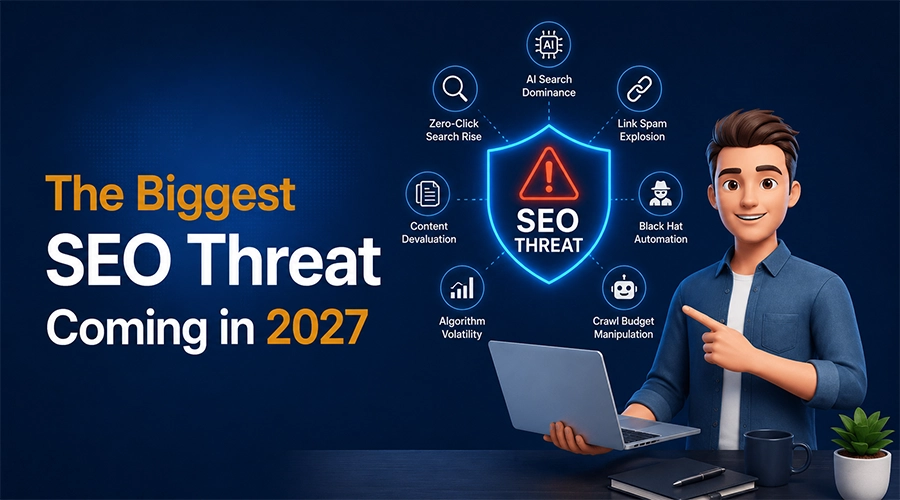
For years, the basic search journey was simple: someone typed a question, scanned the results, chose a website, and continued reading there. That habit is changing, mostly because of the rise of zero-click searches and AI-driven answer engines. Google can now answer many questions before a visitor reaches a website, while ChatGPT, Perplexity, Gemini, Claude, and other answer systems allow people to skip the traditional results page altogether. A 2024 Datos and SparkToro analysis found that 58.5% of U.S. Google searches and 59.7% of EU Google searches ended without a click to an external result.
The situation becomes more serious when an AI-generated answer appears above the conventional results. A 2026 Pew Research Center study found that users clicked a traditional search result in only 8% of visits when an AI summary appeared, compared with 15% when there was no AI summary. This does not mean SEO is dying. It means the job is becoming harder: websites now have to earn attention from both search engines and answer systems.
Key Takeaways:
- Zero-click searches and AI overviews pose real threats to SEO.
- Answer Engine Optimization (AEO) strategies and Google’s latest algorithms are rewriting the visibility rules.
- Monitoring technical SEO and Core Web Vitals can make the difference.
- Content strategy is shifting from volume to authority.
- Backlinks and maintaining topical authority become critical.
Present State of SEO
SEO is currently sitting between two search models. The traditional model still holds ground because to make a website visible, you need to make it crawlable, technically sound, and relevant to queries, which is still in the hands of traditional SEO.
At the same time, answer engine optimization (AEO) also matters because it’s adding summaries, shopping results, maps, videos, discussions, and AI-generated responses around those organic listings. This creates an awkward situation for publishers. A page can appear in search, receive an impression, and still lose the opportunity to speak directly with the visitor. Some growing businesses are quietly losing ground because of this kind of pressure and negative SEO attacks.
In a 2026 research study based on a representative panel of 900 U.S. adults, citations inside Google AI Overviews were clicked in only about 1% of AI Overview visits.
That is the problem businesses should pay attention to. A page can be visible without receiving the same amount of traffic it once received. But this does not mean every business will lose 50% or 60% of its traffic. Search behavior varies enormously by industry, query type, country, device, and intent. A product search and a medical question do not behave in exactly the same way.
That distinction matters when planning for 2027.
Key Drivers of the Threat
Several forces are pushing search in this direction, and three changes deserve particular attention. First, people are writing longer and more conversational queries. Second, search engines are attempting to answer more of those questions themselves. Third, users increasingly have another option: they can ask an AI assistant directly. Research in 2026, based on over 55,393 queries, shows that Google AI Overviews appeared for 13.7% of queries. That finding is worth thinking about. Traditional ranking is still important, but zero-click searches may select and present sources differently.
Latest Algorithms and Search Systems Coming Into the Scene
Google’s algorithms haven’t slowed down just because AI overviews are stealing the spotlight. Its AI features use the same underlying search ecosystem and existing SEO best practices to present relevant answers in AI Overviews and AI Mode.
AI Integration
AI should not be treated as another keyword-placement opportunity. It is now changing the way information is extracted and presented. For a business, content should be written in a way so that its meaning stays obvious and important claims come within the first 100 words, instead of being buried under five paragraphs. From wherever you are taking the data, it should definitely be identifiable. Authors should be visible when expertise matters.
This is even more important for YMYL subjects such as content related to medical treatment, financial decisions, legal obligations, personal safety, or other high-impact subjects, where evidence and qualifications are mandatory. A confident writing style is not a substitute for expertise.
E-E-A-T Signals
The guidance for Google is clear through these E-E-A-T signals, which represent experience, expertise, authoritativeness, and trustworthiness. But bear in mind that E-E-A-T signals are not a single ranking factor. Google trusts content that provides:
- a clear author bio;
- relevant credentials of the agency or author;
- reliable primary or authoritative sources;
- transparent methodology;
- current information;
- clear distinctions between evidence and opinion;
- correction or update processes;
- references that readers can independently verify.
That is much more convincing than writing “we are SEO experts” several times.
Helpful Content
Helpful content is not necessarily long content. Sometimes the best page is 600 words because the question only requires 600 useful words. Adding another 1,500 words to hit a supposed SEO target can make the page harder to use.
Google asks creators to create content that provides original information, research, analysis, or substantial value that readers cannot find anywhere else. It also asks publishers to make content primarily to help people rather than primarily to obtain search traffic.
The Rise of Answer Engine Optimization (AEO)
Answer Engine Optimization is best understood as an extension of good SEO and is one of the most important SEO strategies brands can adopt heading into 2027. The aim is to make information clear enough to be retrieved, interpreted, and accurately represented by answer systems. That means using descriptive headings, answering questions directly, explaining terminology, supporting claims, maintaining factual accuracy, and providing original information where possible. It also means accepting that visibility and traffic are becoming two different measurements.
Optimizing for Google AI Overviews
There is no reliable formula that guarantees inclusion in an AI Overview, but if your content is well-structured, provides direct answers to queries in the first few sentences, and backs itself with credible sourcing, then it ensures its place within AI overviews.
Providing Direct Answers and Original Data
When your content provides almost the same information as the other 10 blogs, AI models won’t want to fetch it in these answers. This is because they favor content that offers uniqueness, fresh perspectives, innovative ideas, along with quotable answers, supported by original research and data.
If you have done a survey, product testing, expert interviews, or industry observations on that topic, provide its insights, and make it first-hand content. These findings make your content unique and innovative, which entirely changes the equation.
Optimize Content for Different AI Tools
Do not assume that visibility in Google automatically means visibility in ChatGPT, Gemini, or Perplexity. All these AI chatbots do not parse and optimize content in the same way. So, analyze the research comparing Google Search, Google AI Overviews, and Gemini to understand how content should be structured so that visibility happens on almost all platforms.
Strengthen Technical SEO
How can an AI fetch your brand’s content when your website takes an enormous time to load and doesn’t even work on mobile screens? Yes, visibility becomes difficult when the technical foundations underneath are shaky. Search engines and AI crawlers both need SEO-friendly web applications. So, focus on technical SEO for better crawling, rendering, indexing, canonicalization, structured data, internal links, mobile accessibility, page performance, and server reliability.
Mobile-First Indexing
Mobile-first indexing is no longer something businesses should treat as a future project. When Google notices the mobile version of your site, it indexes it as the primary version. The mobile version of your site must contain the important content, headings, images, structured data, metadata, and links that search engines need to understand the page.
Structured Data and Schema
Structured data helps search engines understand what information represents. It offers a machine-readable map to AI systems that contains product details, FAQs, reviews, author bio, and much more. This allows them to easily extract your pages into rich results or AI citations when required.
Google’s own documentation shows that this approach improves click-through rates: Rotten Tomatoes reported a 25% increase, while Nestlé reported an 82% increase for pages appearing as rich results.
Fast Loading Pages
Speed becomes a survival factor in today’s SEO landscape. You may think, why? Because a random visitor leaves your website if it takes more than 3 seconds to load. Use the right development framework to improve your website speed.
Focus on Core Web Vitals and UX
User experience (UX) now directly impacts SEO, and that’s why Google currently recommends these Core Web Vitals targets at the 75th percentile:
- Largest Contentful Paint, or LCP, should be less than 2.5 seconds.
- Interaction to Next Paint (INP) should be below 200 milliseconds.
- Cumulative Layout Shift (CLS) must be within 0.1.
Core Web Vitals do not measure every part of user experience, but they provide useful technical signals around loading, responsiveness, and visual stability. Google recommends monitoring them through Search Console and other measurement tools.
Measure SEO Performance
Are you only checking the rankings and sessions? Remember, they are only partly responsible for showing up in results. Now, pondering what to do?
Run an SEO audit to identify crawling errors and indexation status regularly before they erode your rankings.
Create a chart that must contain the statistics of
- impressions;
- organic visits;
- qualified organic visits;
- conversions;
- AI-search visibility.
Remember, search clicks still matter, particularly when the visitor needs to compare products, contact a company, complete a transaction, read detailed information, or verify a source.
Use Lazy Loading and Better Hosting
Lazy loading can reduce the amount of content that needs to be loaded immediately, but it should be implemented carefully and mostly when needed.
Hosting deserves attention too. Slow database queries, inadequate server resources, poor caching, and inefficient application code can create problems that no amount of keyword optimization will fix. A collaborative study found that even a mere 0.1-second improvement in loading time can increase conversions by up to 8.4% for eCommerce sites.
Optimize Images and Browser Caching
Images are often responsible for a surprisingly large part of a webpage’s weight.
Use appropriately sized images, modern formats where suitable, compression, responsive image delivery, and sensible caching. Do not serve a huge desktop image to someone using a small mobile screen simply because it is easier to implement. Small technical decisions like these accumulate across an entire site.
Content Strategy Needs to Change
The easiest content to produce is becoming the easiest content to ignore, because generic content can’t cut through the noise anymore. Just publishing more and more content isn’t the right way to approach it.
Publish content that both human beings and AI systems can trust. That means fewer pages but well-researched content, because the future of SEO starts with questions the business can answer better than a general-purpose publisher.
Build Topical Authority
Topical authority is not about publishing so much content; it’s mostly about covering a topic in depth and building connections among them. Implementing this approach helps you show off your expertise far more effectively than one isolated article on a cloud.
Original Human-Edited Content
Bring a combination of AI drafting with human editing. Someone should be responsible for rechecking the claims and must be able to challenge the conclusions beyond the evidence. The writer should bring some real-life experience to the deck to hold up better against the algorithm updates and reader security.
Refresh Existing Content
Updating an old article should involve more than changing “2025” to “2026.”
Review the evidence.
Check whether links still work. Replace outdated statistics. Remove obsolete recommendations. Update screenshots. Recheck regulations where relevant. Review the author’s credentials. Make sure the conclusion still follows from the evidence. For YMYL pages, factual accuracy should come before publishing frequency.
Link Building in 2027
Backlinks remain useful, but the industry needs to move away from the idea that more links automatically mean more authority. A relevant editorial reference from a respected source can be valuable because it puts the website inside a trustworthy information network. A pile of unrelated links does not necessarily achieve the same thing.
Internal Linking
Internal links are often overlooked because they do not have the glamour of earning a major external mention.
But a well-structured internal linking strategy helps both users and crawlers understand which pages matter most. It also helps in spreading authority across your site, instead of leaving it stuck on one page.
Authoritative Backlinks
Good link acquisition starts with something worth citing. That could be original research, a useful dataset, a technical benchmark, an expert interview, a detailed case study, or a genuinely useful resource.
Businesses should also monitor their backlink profiles. An unusual increase in irrelevant links should be investigated, but it should not automatically be labeled a negative SEO attack. Ranking changes have many possible causes, and evidence should come before conclusions.
Digital PR
Digital PR can support both SEO and reputation. A company that publishes useful data can become a source for journalists. An expert who provides a clear explanation of a complicated subject may be quoted. A technical team that publishes an unusual benchmark can attract references from other professionals.
The value is not simply the backlink.
It is the association between the company, its expertise, and a credible external source.
SEO Trends You Should Follow in 2027
The safest way to think about the Future of SEO is not to predict one revolutionary tactic. Search is moving toward a system in which traditional rankings, generated answers, entities, user intent, technical accessibility, and brand reputation overlap. Some trends are already measurable. Others remain projections and should be treated that way.
Zero-Click Search Exceeds
Industry data compiled together shows mobile searches already sitting at a 77% zero-click rate, compared to 56% on desktop. This direction deserves attention, as it helps businesses to prepare for the possibility by identifying which queries genuinely require a visit to their website.
Retrieval-Augmented Generation (RAG)
RAG allows an AI system to retrieve external information before generating an answer. For websites, the implication is straightforward: information needs to be accessible, clearly written, attributable, and factually reliable if it is going to have a chance of being retrieved as a useful source.
Prompt Engineering Becomes a Core of SEO
Prompt testing can help marketers understand how people phrase questions to AI tools, not just for search engines.
For example:
“What are the leading providers of X?”
“What should a business consider before buying X?”
Then compare this with other brands, sources, facts, and weaknesses.
This should be used as market research, not as an attempt to manufacture an artificial recommendation.
Semantic SEO and Vector Search Turn Content
Search is not confined to some keywords only; it’s moving beyond them by understanding the appropriate meaning and context.
So, build content around exact match phrases and users’ search intent.
That is more useful than forcing the exact target keyword into every paragraph.
LLMs.txt and LLMs-Full.txt
These files are often discussed in SEO circles, but businesses should be careful not to treat them as mandatory ranking requirements.
There is currently no sound basis for presenting them as a guaranteed Google ranking factor.
Technical fundamentals should come first: crawlable pages, correct indexing directives, accessible content, XML sitemaps, appropriate structured data, and a technically healthy website.
Choose Keywords Based on Intent
Research shows that when an AI overview appears, the zero-click rate jumps to 83% and Google AI Mode climbs to 93%. This is where you can notice a persistent gap between informational and transactional intent.
A keyword receiving 50,000 searches may generate less business than a phrase receiving 500 highly qualified searches.
Conclusion
The zero-search clicks and AI answer engines are reshaping every search click and forcing every negative SEO attack response to move faster. In these circumstances, you need to develop evidence-led content that shows trustworthiness, expertise, experience, and authority. It should be backed by links that contain that researched data or statistics. Rather than choosing highly competitive keywords, choose the most common or repeated phrase that users use to search for anything. Incorporate a semantic SEO approach, build topical authority, strengthen technical SEO, and focus on Core Web Vitals and UX. Implementing all these at the same time will help you thrive well in the present digital marketing landscape.
If your website needs a technical, content, and authority overhaul built for 2027, The Tech Clouds (TTC) is ready to help you. Hire SEO experts who blend technical fixes with AI-ready content, and keep your brand visible when it counts.

Frequently Asked Questions
Will SEO still be important in 2027?
Yes. Traditional SEO fundamentals will remain important because Google's AI features still rely on search infrastructure and relevant web content. Google states that there are no additional SEO requirements specifically for appearing in AI Overviews or AI Mode.
What are zero-click searches?
Zero-click searches are those when users get the answers directly on the Google page without visiting any other sites.
Will AI Overviews reduce organic website traffic?
They can. A recent study using browsing data from a representative panel of 900 U.S. adults found that clicks to sources cited inside AI Overviews occurred in only about 1% of AI Overview visits. The study also associated AI Overviews with fewer clicks overall.
How can businesses get their content into Google AI Overviews?
There is no guaranteed formula or separate “AI Overview ranking factor.” Follow the EEAT recommendations set by Google. Also follow the fundamental SEO practices, including crawlable pages, helpful content, clear information, and strong technical foundations. The Tech Clouds (TTC) will help you generate AI-ready content along with technical upgrades.
Does AI-generated content hurt SEO?
Not automatically. Google says it focuses on the quality and helpfulness of content rather than whether AI was used to produce it. However, using automation primarily to manipulate search rankings can violate Google's spam policies.
Can a negative SEO attack cause a website to lose rankings?
Suspicious backlinks or other malicious activity should be investigated, but businesses should not automatically blame a negative SEO attack for every ranking decline. Technical problems, algorithm changes, changing search intent, competitor improvements, content quality, and declining search demand can also cause traffic losses.
Will Answer Engine Optimization replace traditional SEO?
Probably not. AEO is better viewed as an extension of SEO for search environments that provide direct answers. Google's current guidance specifically says that the established SEO best practices remain relevant to AI Overviews and AI Mode.
Recent Posts






Related Blogs

Cloud Application Development in 2027: Trends, Technologies, and Best Practices
The global cloud application development market is expanding rapidly. It is $450.1 billion in 2026 and is projected to reach $806.91 billion by 2030, with a 15.7% CAGR over the...

How Do You Choose the Right Cloud Provider for Your Migration?
Picking a cloud provider for a migration isn't like picking a laptop. You're handing over your data, your uptime, and a good chunk of your budget for years. The wrong...

AI App Development Trends 2027: What Businesses Need to Know
A CTO opens two dashboards side by side. One is his competitor's; the other is his own. The competitor's page was built on an AI system that tracks customers' order...

High CPU Usage on Your Server: Causes, Diagnosis, and Fixes
Suddenly your server feels sluggish? You have seen all requests timing out, and the dashboard showing a red signal screaming: CPU at 100%. Do you know what that sign means...

Why Does My Server Keep Crashing? Common Causes and Fixes
Has your server crashed in the middle of a critical deployment, taking your uptime, your revenue, and peace of mind with it? You’re not alone. Every year, businesses lose thousands...

Common Server Problems and How to Fix Them: The Complete Guide
KeyTakeaways Most slowdowns occur when CPU stays above 90%, and disk I/O wait exceeds 10–20ms. Focusing on DNS authentication and strengthening firewall rules can prevent network hiccups, which are a...

How The Tech Clouds Built a Smarter Website & Server Monitoring Solution
Your website looks nice; nothing felt off. The server seems to be up; who knows? But then you wake up at 2 AM to check whether everything runs as you...
How to Speed Up Your WordPress Site: The Ultimate Optimization Guide
You have gone above and beyond to build your WordPress site, but when a visitor arrives, the loading wheel starts spinning. First 3 seconds gone, then five and so on....