


Quick Commerce App Development: Features, Technology, and Business Benefits
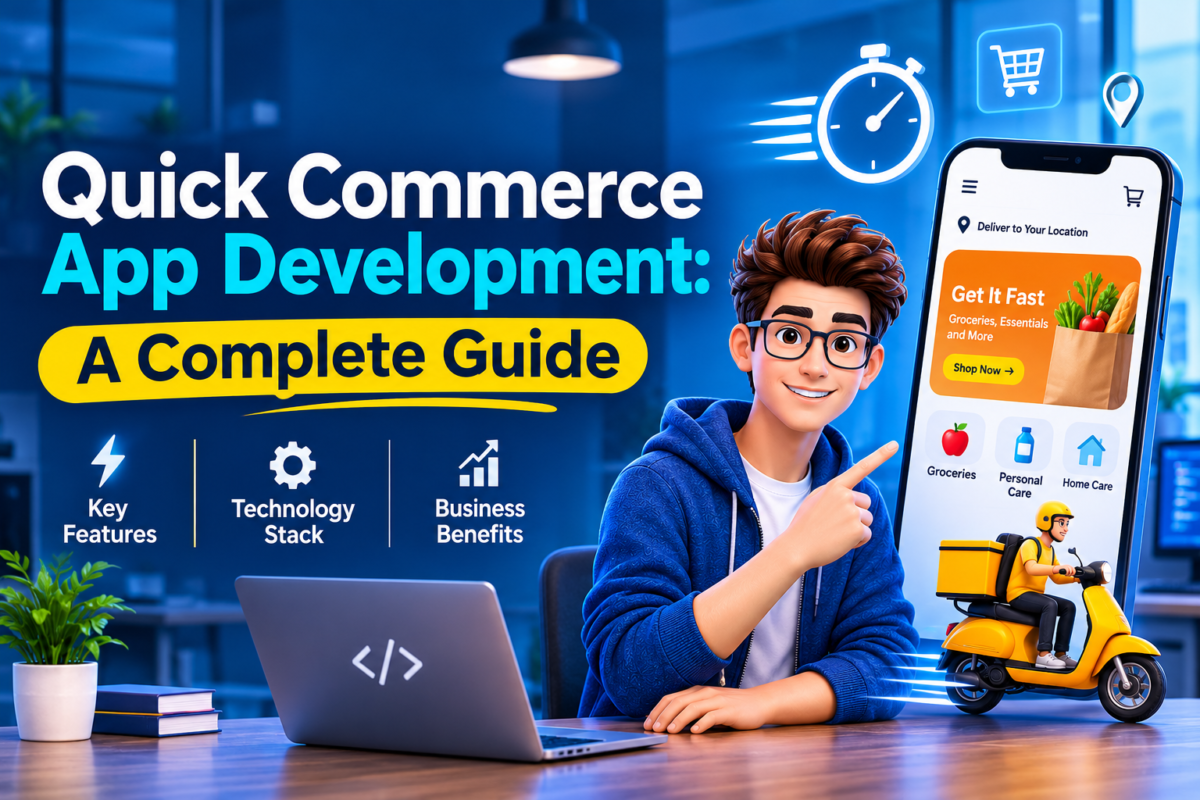
It’s almost 9.45 pm. You return home from your office, totally exhausted. Now you have to make dinner. You enter the kitchen and realize you have hardly any groceries. Not even something that takes less time to cook. You want them now or have to sleep without eating anything. Maybe you can, but your family can’t, right?
Think back a decade: you needed to make a cold walk to the store to buy these things, but now things have changed. You open your phone, order groceries, and have them on your platter within 10 minutes. Sounds great, right?
This is how Quick Commerce applications serve everyone every day, under the hood. That’s why the global quick commerce market is projected to grow from $195 billion in 2025 to $283 billion by 2030, registering a CAGR of 7.74%.
These quick commerce apps go by different names worldwide- Blinkit, Instacart, Flink, Delivery Hero, Getir, and others.
This piece will help you understand what a quick commerce app is, the features it includes, the technology it needs, the business benefits it provides, and what it typically costs to build.
Key Takeaways
- A quick commerce app delivers products within 10-15 minutes.
- The global quick commerce market is expanding rapidly as consumers prioritize speed and convenience.
- These apps mostly rely on dark stores or local retailers located within 2-3 km of consumers’ homes.
- A successful quick commerce app design must support real-time inventory and personalized recommendations.
- Businesses benefit from stronger customer retention and better inventory utilization.
- The right technology stack must include mobile frameworks, cloud infrastructure, APIs, and analytics.
What Is a Quick Commerce Application?
A quick commerce application is a digital platform that lets customers order products and get them within 10–30 minutes. Unlike traditional e-commerce, it coordinates local inventory, micro-warehouses, dark stores, nearby fulfillment centers, and last-mile delivery in real time.
Practically, people understand the applications. But when it’s time to dive deeper and get into the theory, they can’t understand what e-commerce and quick commerce applications are.
The difference is very basic:
One person ordered books, kitchen appliances, grooming products, and car accessories. These items take at least 3-7 days to deliver. Another person bought biscuits, pet food, medicines, and toothpaste, and they arrived within 10-15 minutes.
Although speed is the most noticeable difference between these two applications, many factors also set Quick Commerce apart from eCommerce.
Take a quick glance and clear your doubts:
Quick comparison
| Parameters | eCommerce | Quick Commerce |
|---|---|---|
| Primary focus | Product variety and online shopping | Immediate product availability |
| Product range | Broad | Locally stocked selection |
| Inventory | Warehouses and sellers | Nearby dark stores and retail partners |
| Fulfilment | Standard warehouse processing | Hyperlocal fulfilment |
| Delivery | Standard or scheduled | Usually 10–30 minutes |
| Logistics | Courier and shipping networks | Local delivery partners |
| Purchasing behaviour | Often planned | Often immediate |
| Technology | Catalogue, cart, payment, shipping | Real-time inventory, geolocation, dispatch |
| Business model | Marketplace, D2C, inventory-led | Dark-store or hyperlocal fulfilment |
Benefits Quick Commerce Brings to Businesses
A recent survey of consumers across 17 international markets found that nearly 29% of customers choose quick commerce apps to order fresh fruits, vegetables, medicines, and health products. So, if your company is planning to build a quick commerce application, it’s a solid plan.
Here are the benefits it can bring for your business:
Repeat Orders:
Customers who get every household item by tapping their phone within 15 minutes are more likely to order more items later. Building an app like this can lift lifetime value without extra ad spend.
Stronger Loyalty:
If you stick to your promise of delivering products within 10-15 minutes and offer more products that meet immediate or short-term needs, you build trust and long-term customer loyalty, which helps expand your business.
Extra Revenue:
Not from sales only. You can earn from paid promotions and in-app advertising. So, again, a plus point for higher revenue.
Better Conversion:
Most quick commerce customers are ready to buy. They open the app when they need something immediately, so cart abandonment is rare, and conversion rates are higher.
Better Last-Mile Efficiency:
AI-based features assign the right person to the delivery and show the shortest possible route. This reduces delivery time, fuel expenses, missed deliveries, and delays.
Features of a Quick Commerce Application
The quick commerce app must offer noticeable features that fully satisfy customers, because speed alone can’t keep them happy. McKinsey’s US consumer survey found shoppers rank delivery reliability above speed. When you’re planning for quick commerce app design, you must think of these features:
Real-time Inventory Management:
The app should offer live product availability across warehouses and dark stores. This feature gives customers real-time visibility into what’s available and what’s not. This prevents cancellations after ordering.
Smart Search and Personalization:
Don’t skip features like AI-powered search or filters. More like location-aware suggestions and past-order recommendations. You shouldn’t overlook clean category browsing. This helps users complete purchases in fewer taps.
Live Order Tracking:
Customers expect an accurate map view. Where the rider is right now. The current status of the order. Estimated arrival time and proactive notifications from confirmation to doorstep delivery. All this information makes a quick commerce app feel trustworthy and checkout frictionless.
Secure and flexible payments:
A quick commerce app design succeeds only when it accepts cards, cash, UPI, BNPL, and other options. Include tokenized payment options, and keep refund systems flexible. These options help customers to proceed with confidence.
Rider and Admin Tools:
Your app should use AI systems that assign orders to the right person and guide them with the shortest route and batch orders efficiently. Include pickup verification and a performance dashboard to make operations teams’ work more feasible.
Technology Stack Required to Build a Quick Commerce Application
| Layer | Recommended Technologies | Purpose |
|---|---|---|
| Customer app | React Native, Flutter, Swift, Kotlin | Build fast, reliable iOS and Android shopping experiences. |
| Admin panel | React.js, Angular, Vue.js, Node.js | Manage catalog, orders, users, promotions, and analytics. |
| Design & Prototyping | Figma | Tests quick commerce app design flows before development starts. |
| Delivery-partner app | Flutter, React Native, Google Maps SDK, Mapbox | Enable navigation, task acceptance, proof of delivery, and tracking. |
| Backend | Node.js, Python, Java, Go, Laravel | Handle business logic, APIs, authentication, and order workflows. |
| Real-time engine | WebSockets, Firebase, Kafka | Powers live tracking and instant inventory updates. |
| Database | PostgreSQL, MySQL, MongoDB, Redis | Store product, user, order, and session data with fast retrieval. |
| Cloud and hosting | AWS, Google Cloud, Microsoft Azure | Scale infrastructure during traffic and delivery-demand spikes. |
| Real-time systems | Firebase, WebSockets, Kafka, RabbitMQ | Power live tracking, notifications, inventory sync, and dispatch. |
| AI and analytics | TensorFlow, PyTorch, BigQuery, Power BI | Improve demand forecasting, recommendations, routing, and fraud detection. |
| Payments | Stripe, Razorpay, PayPal, Braintree | Enable secure transactions, refunds, subscriptions, and payouts. |
| Security | OAuth 2.0, JWT, SSL/TLS, encryption, PCI DSS practices | Protect customer data, payments, and platform integrity. |
Quick Commerce App Development needs an API-first, microservices-ready architecture. That approach lets a quick commerce app add new categories, cities, payment methods, or delivery partners without rebuilding the entire platform.
Closing Thoughts
Today, customers value speed and prefer buying from an app that offers convenience. Customers’ expectations are evolving. Quick commerce app development will help you meet those needs. Analyze the current market trends. Follow the customer’s buying behavior. Choose the right model and technology stack. Integrate ultra-fast delivery speed and a remarkable user experience. Tie these to smooth operations and scalable technology. Keep in mind that with these features, your app will dominate the future.
If you’re planning a quick commerce app development, contact us today. Our team starts by evaluating customer preferences and industry trends, then handles design, architecture, launch, and support. Share your idea with The Tech Clouds (TTC) team today, and we’ll help you build something customers will open again tomorrow.

Frequently Asked Questions
What is the difference between e-commerce and quick commerce?
The biggest difference is speed. E-commerce typically delivers within 3-5 days, depending on warehouses and sellers. But quick commerce apps deliver within 10-15 minutes because they fetch the products from nearby dark stores and retail partners.
Which businesses should invest in a quick commerce app?
Businesses like pharmaceuticals, household, beverage, and snack brands, local electronics retailers, and grocery stores can invest in quick commerce applications.
How much does it cost to develop a quick commerce app?
Quick commerce app development costs vary significantly based on the features and scalability requirements. An average cost for a simple MVP ranges from $15,000–$35,000, a mid-level MVP ranges from $35,000 to $90,000, and an advanced MVP costs nearly $90,000 to $190,000.
Recent Posts






Related Blogs

5 AI Coding Agents You Should Try in 2027
Writing code is no longer confined to a quiet environment with just your system and coffee. Reports show that 84% of developers use or plan to use AI tools to...

What Factors Should a Business Consider When Choosing a CRM Development Partner?
CRM is an operational tool that sits between your business and customers. A CRM development partner can transform how your business handles customer relationships. Now that CRM is the only...

Cloud Application Development in 2027: Trends, Technologies, and Best Practices
The global cloud application development market is expanding rapidly. It is $450.1 billion in 2026 and is projected to reach $806.91 billion by 2030, with a 15.7% CAGR over the...

How Do You Choose the Right Cloud Provider for Your Migration?
Picking a cloud provider for a migration isn't like picking a laptop. You're handing over your data, your uptime, and a good chunk of your budget for years. The wrong...

AI App Development Trends 2027: What Businesses Need to Know
A CTO opens two dashboards side by side. One is his competitor's; the other is his own. The competitor's page was built on an AI system that tracks customers' order...

High CPU Usage on Your Server: Causes, Diagnosis, and Fixes
Suddenly your server feels sluggish? You have seen all requests timing out, and the dashboard showing a red signal screaming: CPU at 100%. Do you know what that sign means...

Why Does My Server Keep Crashing? 9 Causes and Fixes
Has your server crashed in the middle of a critical deployment, taking your uptime, your revenue, and peace of mind with it? You’re not alone. Every year, businesses lose thousands...

Common Server Problems and How to Fix Them: The Complete Guide
KeyTakeaways Most slowdowns occur when CPU stays above 90%, and disk I/O wait exceeds 10–20ms. Focusing on DNS authentication and strengthening firewall rules can prevent network hiccups, which are a...