


Cloud Application Development in 2027: Trends, Technologies, and Best Practices
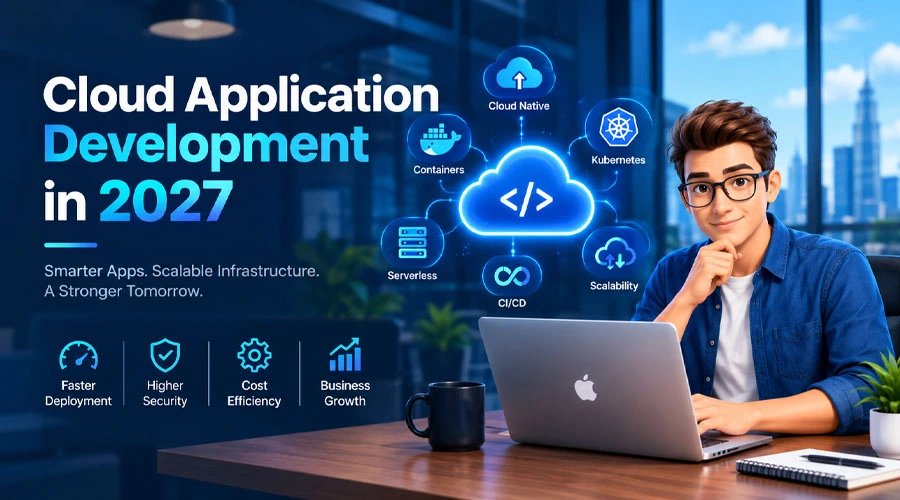
The global cloud application development market is expanding rapidly. It is $450.1 billion in 2026 and is projected to reach $806.91 billion by 2030, with a 15.7% CAGR over the forecast period.
Honestly, the expansion of cloud application adoption has several valid reasons. It lowers IT costs by reducing the dependency on local servers. It is highly scalable and can be scaled up or down as business needs change. As digital transformation grows, cloud applications are a boon because they integrate easily with existing tools like ERP and CRM.
But have you ever wondered how to build these applications? If not, this guide explains the trends, technologies, and practices businesses need to follow to build successful cloud applications.
Let’s start!
Key Takeaways
- AI-assisted development, serverless functions, containers, and edge computing will shape modern applications in 2027.
- Security, monitoring, resilience, and cost control should be planned from the beginning.
- Kubernetes and microservices are useful only when application complexity justifies them.
- Multi-provider strategies can improve flexibility but may increase operational challenges.
- Technology choices should support measurable business and customer outcomes.
What Is Cloud Application Development?
Cloud application development is the process of designing, building, testing, deploying, and maintaining software on cloud infrastructure.
Applications may use virtual machines, containers, serverless functions, managed databases, application programming interfaces, artificial intelligence services, and cloud-based storage.
There are three common approaches:
- Cloud-hosted applications: Traditional applications moved to cloud infrastructure with limited architectural changes.
- Cloud-ready applications: Existing software improved to use cloud features such as automatic scaling, backups, and managed databases.
- Cloud-native applications: Software designed specifically for distributed environments, using microservices, containers, APIs, and automation with strict resilience.
Cloud application selection depends on business operations, workloads, and growth demands.
For example, a startup may need only a single application with one connected database. But a global e-commerce platform may need scalable applications with integration capabilities for payments, inventory management, and more.
Major Cloud Application Development Trends in 2027
Here are some trends that can shape cloud application development services in 2027:
1. AI-Powered Application Development
- AI has become integral to products and services. Think chatbots, personalization, predictive analytics, and smart search.
- AI app development trends aren’t just buzzwords. Instead, it’s a practical business solution that helps companies move faster and more efficiently.
- With AI capabilities, cloud platforms can easily deploy or scale business operations without maintaining underlying computing infrastructure.
2. Serverless and Event-Driven Architecture
- Serverless architecture means applications run in the cloud, and the cloud provider manages them for the development team.
- And event-driven architecture means an application takes action when a specific event occurs.
- These approaches let applications respond quickly to user actions and business events and can automatically scale resources. That’s why 55% of surveyed organizations were already using serverless architecture or FaaS in production.
3. Containerization and Kubernetes
- Containerization and Kubernetes are becoming important trends in cloud application development because they make applications easier to deploy, scale, automate, and manage.
- Containers package an application with the components it needs to run, while Kubernetes helps manage multiple containers across cloud environments.
- Together, they let businesses build applications that respond to changing demand, recover from failures, and support faster development and deployment.
4. Edge Computing and Distributed Cloud
- Edge computing and distributed cloud are becoming key trends in cloud application development as businesses want faster and more responsive applications.
- Edge computing processes data closer to where it is generated, while distributed or multi-cloud architecture makes cloud resources available across multiple locations.
- When they both merge in an application, they can reduce delays and improve performance; maybe that’s why Gartner predicts 90% of organizations will adopt hybrid by 2027.
5. Low-Code & Platform Engineering
- Low-code and platform engineering are two important trends for developing and launching cloud applications faster and more efficiently.
- Low-code tools reduce manual coding, while platform engineering gives developers a proper environment with ready-to-use tools.
- Together, they can help development teams build, test, deploy, and manage cloud applications more efficiently.
Essential Technologies for Cloud Application Development
Trends matter only if you have the tools to act on them. These are the building blocks most teams rely on.
Cloud Platforms and Managed Services
- Cloud platforms and managed services speed up application development by giving teams access to on-demand computing resources and modern tools.
- As part of cloud computing, these platforms provide ready-made infrastructure, built-in security, storage, and other services through a unified environment.
- This reduces the need for manual infrastructure management and lets developers focus on building applications.
Microservices and APIs
- Microservices development services and APIs help businesses build scalable and flexible applications.
- Microservices help build a large application from smaller segments that can scale independently.
- APIs, on the other hand, help these services to communicate with each other and connect with external systems.
Infrastructure as Code
- Infrastructure as Code, or IaC, is the process of setting up the IT infrastructure using code or configuration files instead of doing everything manually.
- Developers can manage cloud infrastructure faster and more consistently, without expanding cloud resources.
- IaC simplifies cloud application development by allowing teams to quickly set up and update infrastructure.
CI/CD and DevOps Automation
- CI/CD and DevOps automation combine coding and testing to develop cloud applications.
- They are becoming a major trend as businesses need to release new features and updates faster while reducing manual work and errors.
- In cloud application development, these practices help teams build, test, deploy, monitor, and update applications more efficiently throughout their development lifecycle.
Observability Tools
- Observability tools like logs, metrics, traces, and graphs help analyze each application’s health and performance.
- As cloud-based applications grow more complex, the need for these tools increases.
- This is mainly because they can quickly detect flaws and pinpoint the root causes of issues.
Best Practices for Building Cloud Applications
Good tools will only work when you maintain an error-free environment and keep using the best practices for building cloud applications:
Design for Scalability and Resilience
- Developers should build cloud applications with scalability and resilience in mind.
- This helps them handle changing workloads and future issues.
- By focusing on these two attributes together, they can create more flexible, reliable cloud applications that support business growth.
Adopt a Security-First Approach
- IBM’s 2025 report found that the global average cost of a data breach was $ 4.44 million, while the average time to identify and contain a breach was 241 days, so a security-first approach has become mandatory.
- This approach helps protect your business information and user data from malicious threats.
- This practice also reduces data breaches and helps businesses maintain user trust and compliance.
Continuous Monitoring Cloud Resources
- Flexera’s 2025 State of the Cloud report found 84% of organizations struggle to manage cloud spend.
- But businesses that practice continuous monitoring and resource management reduce cloud costs significantly.
- Right-size resources and remove unused services to help developers build cost-effectively.
Improve Performance and User Experience
- Focusing on UX is no longer trivial, because the better your performance and UX, the better your organization’s visibility will be.
- So, make cloud applications that are faster, more responsive, easier to use, and more reliable.
- Focus on optimizing code, reducing load times, database performance, and using scalable cloud resources across devices for better user satisfaction.
Automate Testing and Deployment
- Testing should be done at each stage, so it is repetitive.
- Use tools and processes that make testing and deployment faster and more consistent, with minimal effort.
- You can also choose the right cloud service provider to speed up development and reduce deployment errors.
Cloud Application Development Process for 2027
In 2027, the cloud application development process should look like:
- Discovery & Planning: Define business goals, users, technical requirements, and success metrics.
- Strategy & Architecture: Select the appropriate cloud model and service architecture.
- Design & Security: Design the application, data flows, security controls, and integration strategy.
- Build & Integration: Build modular services using version-controlled code.
- Testing & QA: Test functionality, performance, security, resilience, and accessibility.
- Deployment & CI/CD: Deploy through automated CI/CD pipelines.
- Monitoring & Optimization: Monitor the application and continuously improve performance, reliability, security, and cost.
Conclusion: Preparing for Cloud Application Development in 2027
Seeing the current cloud application development scenario, it’s confirmed that if your business is not putting any effort into blending AI, containers, or edge computing, then you will definitely lag behind. So, definitely think about including them in your development process. Choose the right technologies such as Microservices, IaC, CI/CD, and DevOps, and follow the right practices to deliver better outcomes.
If you’re planning a new cloud app and need expert support, call The Tech Clouds (TTC). Our cloud specialists will be happy to help. Our cloud application development services cover architecture planning, custom builds, migration, and replatforming. So, talk now and map out your next cloud project!

Frequently Asked Questions
What are the biggest cloud application development trends in 2027?
AI-assisted development, serverless and event-driven design, containers with Kubernetes, edge and distributed cloud, and low-code with platform engineering are the big five.
Is serverless better than containers?
Neither wins every time. Serverless suits event-driven, variable workloads and fast delivery. Containers suit complex apps that need portability, tighter control, and independent scaling. Plenty of teams use both.
How does AI affect cloud application development?
It speeds up coding, testing, and debugging, and powers features like search and support bots. It also needs governance for privacy, accuracy, bias, and human review.
What is the role of Kubernetes in cloud-native applications?
Kubernetes deploys, scales, and manages containerized apps across environments. It keeps services running, restarts failed ones, and scales each service independently as demand changes.
Recent Posts





Related Blogs

What Factors Should a Business Consider When Choosing a CRM Development Partner?
CRM is an operational tool that sits between your business and customers. A CRM development partner can transform how your business handles customer relationships. Now that CRM is the only...

How Do You Choose the Right Cloud Provider for Your Migration?
Picking a cloud provider for a migration isn't like picking a laptop. You're handing over your data, your uptime, and a good chunk of your budget for years. The wrong...

Server Security Hardening: Best Practices to Protect Your Infrastructure in 2027
Server security hardening is the process of strengthening your server by systematically configuring it, applying updates, limiting unnecessary access, disabling unused services, and minimizing vulnerabilities to malware and other cyber...
AI App Development Trends 2027: What Businesses Need to Know
A CTO opens two dashboards side by side. One is his competitor's; the other is his own. The competitor's page was built on an AI system that tracks customers' order...

High CPU Usage on Your Server: Causes, Diagnosis, and Fixes
Suddenly your server feels sluggish? You have seen all requests timing out, and the dashboard showing a red signal screaming: CPU at 100%. Do you know what that sign means...
Why Does My Server Keep Crashing? Common Causes and Fixes
Has your server crashed in the middle of a critical deployment, taking your uptime, your revenue, and peace of mind with it? You’re not alone. Every year, businesses lose thousands...
Common Server Problems and How to Fix Them: The Complete Guide
KeyTakeaways Most slowdowns occur when CPU stays above 90%, and disk I/O wait exceeds 10–20ms. Focusing on DNS authentication and strengthening firewall rules can prevent network hiccups, which are a...
How The Tech Clouds Built a Smarter Website & Server Monitoring Solution
Your website looks nice; nothing felt off. The server seems to be up; who knows? But then you wake up at 2 AM to check whether everything runs as you...