


Should Your Business Outsource Cybersecurity or Build an In-House Security Team?
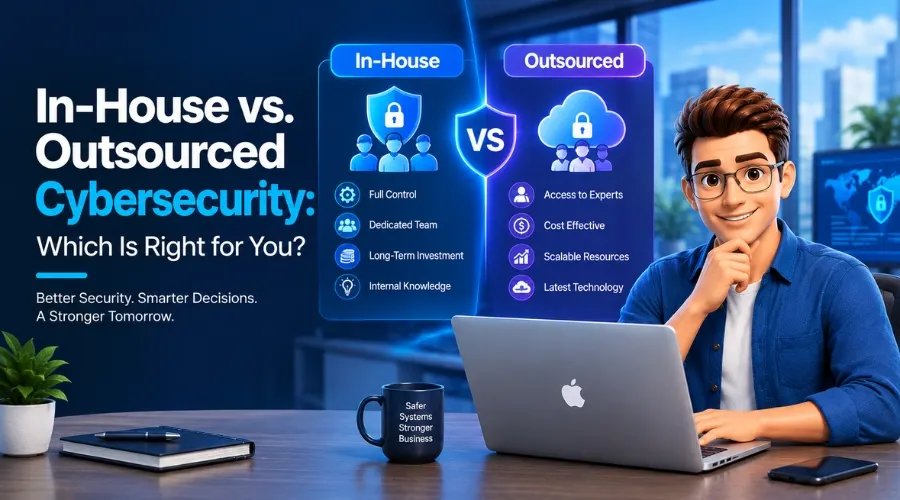
Cybersecurity is no longer optional. It’s now essential to daily business management. Researchers recorded more than one million phishing attacks in the first quarter of 2025. Verizon’s report found ransomware in 51% of analyzed Asia-Pacific breaches. With these threats rising, businesses should consider how to harden their security defenses.
But this is where they get stuck and ask an important question: should we build our own security team or hire an experienced cloud security provider?
The answer is: do whatever your business feels is best. It fully depends on your data sensitivity, compliance rules, budget, and IT infrastructure.
This blog answers your questions by comparing the two models, breaking down their costs, and explaining when each makes sense.
Key Takeaways
- The right model depends on your size, data sensitivity, compliance needs, budget, and risk tolerance.
- An in-house team gives you control and business context, but it comes with high fixed costs and hiring challenges.
- Outsourcing brings fast access to specialists and 24/7 coverage, but you give up some direct control.
- Outsourcing the work doesn’t outsource accountability; you’re still responsible for your data and compliance.
- A hybrid model often works best, with strategy and risk decisions in-house and monitoring and specialist work handled by a provider.
What In-House Cybersecurity Means
An in-house team is the company’s own group of cybersecurity professionals, including a CISO, security engineers, a compliance manager, and an incident-response checklist.
They plan daily how to strengthen the company’s servers and cloud resources. They also do the following:
- Operate tools and handle incident response.
- Train employees on security awareness.
- Respond to incidents.
- Maintain security policies.
- Support audits and other compliance requirements.
Advantages and Challenges of an In-House Team
| Advantages | Disadvantages |
|---|---|
| Proximity: Inhouse team is all time available in your office, so they’re the most available ones during any incidents. | High fixed costs: Salaries, benefits, retention, ongoing training, security tools, and management oversight. Recruitment and onboarding also take time. |
| Clearer accountability: In-house security teams aware of your business operations which helps with governance and compliance, to a great extent. | Talent shortage: Qualified people are hard to recruit and keep. The global cybersecurity workforce gap reached approximately 4.76 million professionals. |
| Business context: Staff know your applications, workflows, and priorities. | Coverage gaps: A small internal team may only work during business hours, leaving systems exposed during nights, weekends, and holidays. Cyberattacks do not follow office schedules. |
| Dedicated expertise: You will get dedicated expertise at your business fronts, highly beneficial for businesses with highly sensitive data or unusual infrastructure. | Skill limits: One analyst can’t realistically master cloud security, forensics, compliance, and incident response. |
| Direct control: Leadership sets priorities, approves tooling, and oversees incident-response decisions. | Burnout: Alert fatigue and turnover add more pressure. |
What Is Outsourced Security?
As the in-house team challenges above show, no single person can master every trade. That’s why businesses look for outsourced cybersecurity. But does that decision pay off? An outsourced cybersecurity team does more than standard monitoring. They bring in third-party applications to deliver your security functions.
Here are the services they provide:
- 24/7 monitoring.
- Penetration testing.
- Firewall and endpoint management.
- Vulnerability scanning.
- Compliance assessments.
- Incident-response support.
- Security awareness training and so on.
Many providers also use a sandbox in cybersecurity to identify and isolate suspicious files. So, analysts can study them without risking your live systems.
Advantages and Risks of Outsourcing
| Advantages | Disadavantages |
|---|---|
| Speed: You get specialist expertise without spending months recruiting. | Less direct control: You rely on the provider’s people, tools, and priorities, so you can’t always decide how or when an issue gets handled. |
| Round-the-clock coverage: Monitoring and response happen outside business hours. | Weak SLAs: If the contract doesn’t spell out response times and responsibilities, alerts can sit unanswered, and nobody clearly owns the problem. |
| Lower upfront costs: No expenses for recruiting, salaries, and training only a predictable monthly or annual amount, which makes budgeting easier. | Context gaps: An outside team doesn’t know your systems the way your staff does, so it may miss which workflows are business critical. |
| Scalability: Services can grow as you add staff, locations, or cloud workloads. | Hard to switch: If logs, configurations, and documentation aren’t kept up to date, moving to a new provider gets slow and messy. |
| Broader capabilities: One provider can offer threat intelligence, penetration testing, compliance support, and incident response, which would take several hires to build in-house. | Accountability stays with you: The provider runs the day-to-day work, but you’re still responsible for your data and compliance. |
In-House vs. Outsourced: Key Differences
Neither model is automatically better. The right choice depends on the organization’s risk profile, budget, compliance needs, and internal technical maturity.
| Factors | In-House Security Team | Outsourced Cybersecurity |
|---|---|---|
| Cost structure | Salaries, benefits, recruitment, training, and tools | Usually a recurring service fee |
| Expertise | Limited to the skills the company hires | Access to a wider range of specialists |
| Coverage | Depends on internal staffing and shifts | Often includes 24/7 monitoring |
| Business knowledge | Strong understanding of internal systems | Requires onboarding and knowledge sharing |
| Control | Direct oversight of tools and priorities | Governed by contracts and service-level agreements |
| Scalability | Hiring takes time | Services can often scale more quickly |
| Best fit | Larger or highly regulated organizations | SMBs and companies needing immediate expertise |
When to Build an In-House Cybersecurity Team
An in-house team may be the better choice when:
- The company can afford multiple security roles and supporting tools.
- It handles highly sensitive data or operates in a heavily regulated industry.
- Security is critical to business operations and the company wants a competitive advantage.
- It uses proprietary systems that require specialized internal knowledge.
- Leadership needs direct, real-time control over security decisions.
- The organization already has mature IT operations and can support a dedicated security function.
When to Outsource Cybersecurity Team
Outsourcing is a better choice when:
- You need a more predictable budget and want to reduce cloud costs.
- You are growing quickly or migrating systems to the cloud.
- You need specialized services such as MDR, penetration testing, threat intelligence, or compliance support.
- The business wants 24/7 server monitoring and prompt incident response.
- Your in-house team lacks experienced security personnel and needs instant protection.
Cost: Compare Total Ownership
Businesses should not compare only payroll with a provider’s monthly fee.
- The in-house model should include salaries, recruitment, benefits, training, recruitment, and high-cost tools.
- But whenever you outsource a cybersecurity team, you won’t need to pay that ransom amount; instead, the cloud costs will be lower and be more predictable.
Both models must also account for breach of costs. Data Breach Report found a global average breach cost of $4.44 million, while the average cost in the United States reached $10.22 million.
The goal is not simply to choose the lowest-cost option. It is to choose a model that reduces risk at a sustainable cost.
The Hybrid Model: A Practical Middle Ground
Frankly, for many businesses, the answer shouldn’t be in-house vs. outsourced cybersecurity. Instead, it should be both.
A hybrid model blends in-house and outsourced cybersecurity teams.
- The in-house team focuses on strategic decisions, security policies, governance, and compliance.
- An outsourced team focuses on monitoring solutions, alert triage, scalability, and broader capabilities even after specific business hours.
After implementation, you’ll notice this approach provides internal accountability.
Questions to Ask Before Deciding
Before choosing a model, business leaders should answer these questions:
- What data, systems, and processes are most critical to protect?
- What compliance requirements apply to the business?
- Does the company need 24/7 monitoring and response?
- What security skills already exist internally?
- What can the business realistically spend on people, tools, and incident responses?
- Which security tasks would create the greatest risk if delayed or handled poorly?
The answers will show which functions should remain internal, which can be outsourced, and where a hybrid model makes sense.
Final Take
The choice between in-house and outsourced cybersecurity depends on your business operations and compliance needs.
In-house teams give you full control and context but can’t keep costs down or work beyond business hours. An outsourced cybersecurity team can reduce costs and give you broader capabilities in alert solutions, penetration testing, compliance support, and incident response.
So, neither is the best. Only the hybrid model can give you the best of both worlds.
Still confused about which one to choose? Connect with our team today. At The Tech Clouds (TTC), we help businesses sort out their security setup by strengthening it, building internal capability, bringing in managed support, or combining both. If you’re not sure where your business stands, contact TTC today and let’s work out the right fit together!
Frequently Asked Question
Can a small business outsource all cybersecurity work?
Yes, they can. Security becomes an integral part of every business operation regardless of size. An outsourced team can handle incident response, vulnerability scanning, alert triage, and 24/7 monitoring for predictable cost.
Does outsourcing remove my compliance responsibility?
No, it doesn’t guarantee that. A provider can implement controls and prepare audit evidence, but your business remains responsible for meeting its regulatory needs.
What should I look for in a cybersecurity provider?
You must consider the following factors while choosing the cybersecurity provider:
• Experience.
• Documentation and reporting process.
• Service-level agreements.
• Incident response processes.
• Clear communication.
• Transparent pricing.
Recent Posts




Related Blogs
Server Security Hardening: Best Practices to Protect Your Infrastructure in 2027
Server security hardening is the process of strengthening your server by systematically configuring it, applying updates, limiting unnecessary access, disabling unused services, and minimizing vulnerabilities to malware and other cyber...