


The Truth Behind 8 Common Website Design Myths
We don’t just build websites; we build websites that SELLS
― Dr. Chris Dayagdag
Yes, it is a truth that no one can deny.
Good design is important to sell a website. Do you know 75 % of website credibility comes from design? Credibility makes a website sell.
So, the logic is simple here. The better the design, the higher will be its relevance, credibility, and market value.
We would like to break some website design myths in light of this. In the presence of myth, no one can achieve good design to capture leads and boost sales.
What Are The Common Website Design Myths?
Web Design Myth 1: Appearance in Website Design Outweighs Functionality
Many website owners think that good website design means the aesthetics or appearance of the website. It has nothing to do with functionality or usability. In fact, website appearance is more important than website design.
What’s The Truth?
It’s a half-truth, or you can say it’s just one side of a coin. Yes, you need an eye-catching website design to attract attention. But it is not everything. A good design means clarity, simplicity, uniqueness, and functionality. Because these features add value to users and create the best user journey.
Website Design Myth 2: Mobile Responsiveness is a Nice-to-Have, But Not a Vital Feature
Some business owners still take mobile responsiveness as an option but not a mandatory feature. It is one of the common website design myths that need more light.
What’s The Truth?
Mobile responsive design is not an option anymore for business websites. Those days are gone! These days building responsive websites has become a critical SEO strategy. Most active internet users access the internet from various devices, like smartphones and tablets.
In this case, for more understanding, you can consider Google’s Mobile-first indexing policy.
Website Design Myth 3: Affordable Website Design and Cheap Website Are Same
Most small business or local business owners do not consider affordable website design out of fear of cheap quality. They think only cheap website design comes at an affordable price. As a result, they stay in the back seat in this competitive realm.
What’s The Truth?
An affordable website is a cost-effective way to get a professional website at an affordable price. Affordable website design offers a good website using scarce resources in the best way. Developers try to provide professional quality as much as possible in a minimalistic way.
Hence we can say that an affordable website provides high ROI. It is far better than a cheap website design.
Website Design Myth 4: One-Time Design, and You’re Done
Sometimes businesses think once they complete the design, they are all set. They do not recognize the importance of routine maintenance and website updates.
What’s The Truth?
It is one of the most common web design myths. So, let us spill the bin. The fact is website design is not a one-time task rather it is an on-going process. You have to conduct routine maintenance and updates to keep website performance at an optimal level.
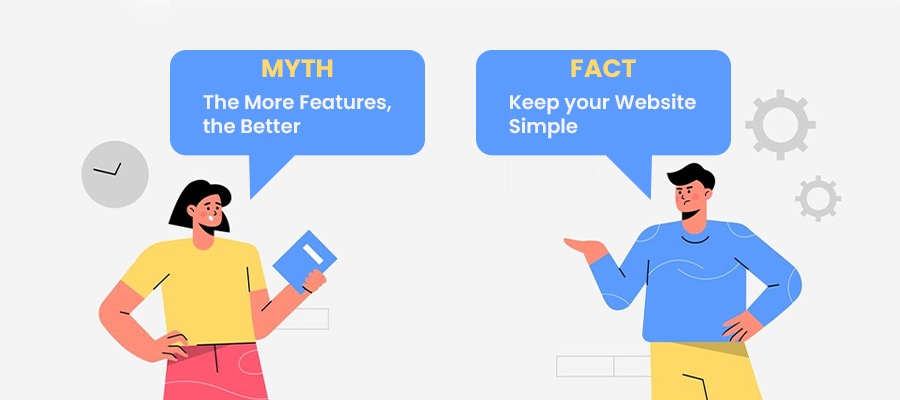
Website Design Myth 5: Customer Satisfaction Increases with More Features
A lot of B2B and B2C clients of our web development services ask us to add a lot of features even the irrelevant ones. They think more features make the website look cutting edge and make customers satisfied.
What’s The Truth?
This is absolutely the biggest myth in web design. A greater number of features do not make a website modern and highly desirable. Most of the time, it distracts users and hampers the conversion process.
Hence, you need only the best dynamic websites that are relevant to your target customers. That is why, a good website design does not include irrelevant add-ons.
Website Design Myth 6: The Homepage Holds the Highest Importance
Most website owners think that the homepage takes the attention above all else. That is why, it is crucial to give more focus on the home page rather than other pages.
What’s the Truth?
The complete fact is different in this case. Although elements of a website homepage are crucial, they are not the only component of a website. All pages in a website need specific design strategies and attention. So, you need to allocate your attention equally to all pages including the homepage or landing page and the services/product pages.
If your site has other pages like careers, about us, FAQs, Contact details, or gallery, allocate time to all web designs.
Website design myth 7: Website Content Does Not Affect Web design
Most website owners do not even realize the importance of website content. According to them, it is a secondary element of a website. It does not affect the web design quality at all.
What’s The Truth?
This is one of the most common website design myths that you should avoid at any cost. Website content is a critical part of website design. It represents the relevance of a site by delivering value to a website audience. However, overusing content may harm the UX of the design. So, make sure to use crisp and limited content in the most effective way throughout the website. You can keep a news or blog section on your website or use visual content as well.
Website Design Myth 8: White Space is a Waste
Most business owners think that white space is a waste of space. Here, they can include some more content or elements. It makes no difference in website relevance.
What’s The Truth?
White space helps in the implication of the golden rules of website design. It creates a breathable space between content and CTAs. It also makes a website more effective and useable. It engages users and helps them to consume all elements easily.
Wrapping Up
Online visibility has become a new standard of social proof for brands. Hence there is no way to ignore the importance of building a website or considering it a luxury. That is why, you have to come up from the confused zone and see beyond these website design myths to achieve success in this competitive landscape of business.

Hire TTC Team to Get an Affordable Website design
We are one of the reliable expert teams to get professional website design in India. We help small, local, and midsized businesses to start their online journey. Mail us today to consult a free strategy from us!
Frequently Asked Questions
Recent Posts






Related Blogs

Cloud Application Development in 2027: Trends, Technologies, and Best Practices
The global cloud application development market is expanding rapidly. It is $450.1 billion in 2026 and is projected to reach $806.91 billion by 2030, with a 15.7% CAGR over the...

How Do You Choose the Right Cloud Provider for Your Migration?
Picking a cloud provider for a migration isn't like picking a laptop. You're handing over your data, your uptime, and a good chunk of your budget for years. The wrong...

AI App Development Trends 2027: What Businesses Need to Know
A CTO opens two dashboards side by side. One is his competitor's; the other is his own. The competitor's page was built on an AI system that tracks customers' order...

High CPU Usage on Your Server: Causes, Diagnosis, and Fixes
Suddenly your server feels sluggish? You have seen all requests timing out, and the dashboard showing a red signal screaming: CPU at 100%. Do you know what that sign means...

Why Does My Server Keep Crashing? Common Causes and Fixes
Has your server crashed in the middle of a critical deployment, taking your uptime, your revenue, and peace of mind with it? You’re not alone. Every year, businesses lose thousands...

Common Server Problems and How to Fix Them: The Complete Guide
KeyTakeaways Most slowdowns occur when CPU stays above 90%, and disk I/O wait exceeds 10–20ms. Focusing on DNS authentication and strengthening firewall rules can prevent network hiccups, which are a...

How The Tech Clouds Built a Smarter Website & Server Monitoring Solution
Your website looks nice; nothing felt off. The server seems to be up; who knows? But then you wake up at 2 AM to check whether everything runs as you...
How to Speed Up Your WordPress Site: The Ultimate Optimization Guide
You have gone above and beyond to build your WordPress site, but when a visitor arrives, the loading wheel starts spinning. First 3 seconds gone, then five and so on....