


Server Monitoring vs. Server Management: What’s the Difference?
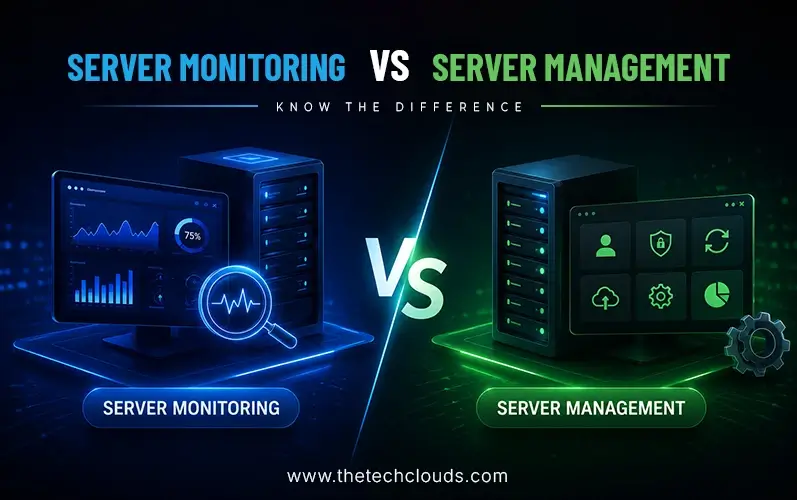
Server monitoring vs. server management is one of the most confusing topics. Business owners think that they need only one approach to run their websites, email, and apps through servers. But businesses that combine these two approaches have achieved better results and smoother workflows.
Server monitoring continuously assesses your server’s issues in real-time and notifies you if anything goes wrong. Server management is the next step. When issues are detected, it comes with hands-on experience to fix the problem. It helps your server remain secure and optimize performance 24/7. Businesses need both to run their workflow. One will tell you what the problem is, and the other will fix it.
This blog describes their basic operations and how they differ. It also explains why monitoring alone is insufficient and what benefits businesses can achieve when they combine the two. So, without waiting any longer, let’s get started.
In a Nutshell:
- Server monitoring detects issues, and server management solves them.
- Monitoring offers deep visibility into server health, and management helps fix problems, particularly at the point where they occur.
- Their working processes are different but mutually inclusive.
- When they act as a single unit, it helps reduce downtime and improve server performance.
- Businesses benefit the most when they are invested in both simultaneously.
Quick Answer: What’s Better?
Honestly, neither is “better” on its own.
Monitoring tells you what’s wrong, and management fixes it.
If you pick only one, you’ll either know about problems with no fix, or get fixes without knowing why they happened.
The smart move is to run both side by side so issues are caught fast and solved properly, 24/7.
What is Server Monitoring?
As the name suggests, server monitoring is the continuous tracking of your server’s health, performance, and availability, around the clock. It includes some monitoring tools, such as SQL Server Management Studio, that are focused on detecting issues. As soon as they detect them, they give you a signal so that you can understand that something is not right.
When Do Businesses Need Server Monitoring?
- When you are running an e-commerce business, downtime can cost a ransom; these businesses must need server monitoring services.
- When you have websites or applications that must stay online.
- When performance issues occur frequently.
- When businesses want early warning alerts.
- When customer experience depends on server speed.
- When teams need 24/7 server monitoring to understand where the issues actually lie.
What Is Server Management?
Server management is the ongoing process of maintaining, updating, securing, and optimizing servers. This process follows a series of steps, including software updates, backups, security checks, user management, troubleshooting, and performance tuning. Professional server management helps to restore your servers to an error-free state and improve their performance.
When Businesses Need Server Management?
- When servers require regular updates.
- When security is a business priority.
- When backups must be managed properly.
- When internal IT resources are limited.
- Reliable server management services help you fix the problem where it actually occurs, rather than altering the whole system.
5 Key Differences That Show They Are Not the Same
| Features | Server Monitoring | Server Management |
|---|---|---|
| Primary Focus | Detecting issues. | Maintains and improves the server. |
| Focus | Alerts and visibility. | Maintenance and optimization. |
| Timing | Watches continuously. | Works continuously to maintain and resolve problems. |
| Scope | Limited to monitoring tools and software. | Covers complete infrastructure administration. |
| Response | Notifies administrators. | Takes direct action to resolve identified problems. |
| Typical Tasks | Uptime and performance tracking. | Updates, backups, and security. |
| Goal | Find problems quickly. | Prevent and fix issues. |
Why Is Monitoring Alone Not Sufficient?
Server monitoring can tell you that something is wrong, but it doesn’t always solve the problem. A server may send alerts about high memory usage or failed services, yet someone still needs to investigate, repair, update, and secure the system. That is where server management services become important.
Scenario: When Both Server Monitoring and Management Work Together
[Monitor]
↓
[Detect Issue]
↓
[Send Alert]
↓
[Investigate Root Cause]
↓
[Resolve / Patch / Restore]
↓
[Optimize & Document]
↺ (back to Monitor)
In plain words: A server monitoring tool watches the server, catches anomalies, fires alerts, engineers dig in, fix the cause, then tune settings and log what happened so the next incident is faster or avoided.
5 Benefits When Both Work Together
Faster Problem Detection & Resolution:
Monitoring identifies the problem, whereas the server property management solutions take action to resolve it. Splunk research suggests that organizations that invest in observability practices detect and resolve incidents by up to 79% faster.
Less Downtime
With 24/7 server monitoring and regular maintenance, many problems can be detected early and fixed before they cause major outages that affect customers or employees. According to the IDC report, businesses that run these two services in parallel experience 15% fewer downtime incidents per year.
Better Performance
Monitoring practices check for regular issues, and server management services respond to those issues immediately. This strategy minimizes downtime and high revenue loss, while improving speed and efficiency. When they work together, they help keep your server stable and improve performance.
Stronger Security:
Monitoring tools like SQL Server Management Studio make it easy to detect if someone is trying to breach your data. As soon as it realizes something fishy, it sends signals to the server management team. With extensive expertise in security patching and access controls, they help reduce vulnerabilities and business risk.
More Reliable Business Operations:
When monitoring and management work together, servers become stable and predictable. Teams spend less time dealing with emergencies and more time focusing on business growth. 90% of organizations invest in both to receive higher server availability and 52 minutes of unplanned downtime per year.
Which One Does Your Business Need?
If your site or app going down hurts revenue or reputation, you need both.
Start with an effective server monitoring solution and keep your eyes on uptime. Later, add server management services so you don’t have to wake up at 3 a.m. to babysit security patches and backups. Most businesses nowadays use both to stay ahead of the curve.
Have a server challenge? Let’s solve it together!
The Bottom Line
Server monitoring and server management are not mutually exclusive; they are partners. There are some differences in their work processes, but they do not oppose each other or act as substitutes. Instead, one works in parallel with the other to keep your system stable and secure.
If you want to achieve consistent uptime or high performance, contact The Tech Clouds (TTC). Our server property management services ensure that every part of the server remains in optimal condition, keeping your business processes smooth and transparent.

Frequently Asked Questions
What makes server monitoring valuable for businesses?
Implementing server management services without knowing where the issues actually lie drains your money and effort. Businesses need to invest in monitoring to detect issues and send signals.
Which tasks are typically included in server management?
It covers software updates, security patching, backups, and performance tuning.
Recent Posts






Related Blogs

Cloud Application Development in 2027: Trends, Technologies, and Best Practices
The global cloud application development market is expanding rapidly. It is $450.1 billion in 2026 and is projected to reach $806.91 billion by 2030, with a 15.7% CAGR over the...

How Do You Choose the Right Cloud Provider for Your Migration?
Picking a cloud provider for a migration isn't like picking a laptop. You're handing over your data, your uptime, and a good chunk of your budget for years. The wrong...

Server Security Hardening: Best Practices to Protect Your Infrastructure in 2027
Server security hardening is the process of strengthening your server by systematically configuring it, applying updates, limiting unnecessary access, disabling unused services, and minimizing vulnerabilities to malware and other cyber...

High CPU Usage on Your Server: Causes, Diagnosis, and Fixes
Suddenly your server feels sluggish? You have seen all requests timing out, and the dashboard showing a red signal screaming: CPU at 100%. Do you know what that sign means...
Why Does My Server Keep Crashing? Common Causes and Fixes
Has your server crashed in the middle of a critical deployment, taking your uptime, your revenue, and peace of mind with it? You’re not alone. Every year, businesses lose thousands...
Common Server Problems and How to Fix Them: The Complete Guide
KeyTakeaways Most slowdowns occur when CPU stays above 90%, and disk I/O wait exceeds 10–20ms. Focusing on DNS authentication and strengthening firewall rules can prevent network hiccups, which are a...

How The Tech Clouds Built a Smarter Website & Server Monitoring Solution
Your website looks nice; nothing felt off. The server seems to be up; who knows? But then you wake up at 2 AM to check whether everything runs as you...

What Is The Difference Between Cloud Computing and Cloud Migration?
Businesses today aren’t just building in the cloud; they are constantly rethinking where and how their systems run. That’s where the concept of cloud migration comes in: moving your on-premises...