


What’s the difference between a CRM and a CDP?
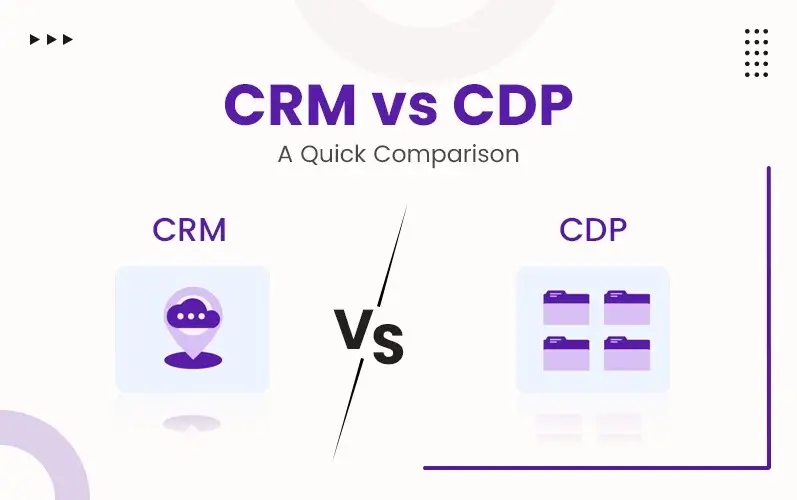
CRM stands for Customer Relationship Management. On the other hand, CDP means Customer Data Platform. People often become perplexed with these two terms. Most of them think that they are both the same. But in reality they’re completely different in terms of capabilities and the purpose they serve.
CRM manages customer relationships. It aids in retaining customers for the longer term and in continued business expansion. Contrastingly, CDP unifies every single piece of information of a customer from different touchpoints under one platform.
Understanding CRM vs. CDP clarifies strategic data utilization approaches. Selecting correctly directly impacts revenue, retention, and scalability. So, brace yourself to know what each of them truly means and how they manage data. Also learn whether they work together or not and the most anticipated differences.
Key Takeaways
- CDP and CRM serve different purposes—CDP focuses on unified customer data, while CRM manages customer relationships and sales interactions.
- CDP automatically collects data from multiple digital touchpoints to create a complete customer profile.
- CRM stores interaction-based data such as emails, calls, deals, and support tickets.
- CDP supports marketing personalization and audience segmentation, while CRM helps sales and support teams manage leads and customers.
- Combining CDP and CRM gives businesses deeper customer insights and improves marketing, sales, and customer experience.
What is CDP?
A CDP, or Customer Data Platform, is a software system that gathers customer data from multiple sources. It could be websites, mobile apps, email campaigns, and offline transactions. Then combine them into a unified customer profile.
Unlike traditional databases, CDPs automatically collect and organize data. It creates a single, accurate view of each customer. CDP helps incorporating the company’s tech stack with custom integrations. It also simplifies the data flow between them. Integrating CDPs, companies can comply with data privacy regulation protocols like the GDPR and CCPA. This helps to mask data and provide role-based access controls.
How CDPs manage data
- CDP uses APIs and code to automatically fetch customer data from different touchpoints. These are all “first-party data” that comes through forms, cookies, and other online engagements. So, the company has comprehensive control over them.
- But some data comes from external sources. Companies do not have direct access to alter these data. They are termed “third-party data.” These data can be bought, stolen, or used without permission, and they’re not the type of information you want to store.
- CDP collects data from various sources. It cleans, standardizes, and removes duplicate records from it.
- It merges anonymous and known user data through identity resolution. This helps in analyzing your target audience’s behavior.
- After that, it integrates them into a single, unified system, providing real-time data activation. This way of keeping data is great for marketing and personalization.
What is CRM?
CRM is a customer relationship management tool. This system helps businesses manage interactions with leads and customers. It tracks communication history, sales pipelines, support tickets, and contact details.
CRM platforms are primarily designed for sales, support, and customer success teams.
How do CRMs manage data?
- CRMs are record repository systems. It stores contact information and customer communication records.
- It tracks sales opportunities and deal stages.
- CRMS maintains notes from calls, emails, and meetings.
- Sales, marketing, and customer service teams mainly use it to manage support requests and follow-ups.
- CRM data is typically interaction-based and often entered by sales or service representatives.
- CRM tools are now following some innovative CRM automation trends. This includes:
- AI-powered insights and predictive analytics.
- Voice and conversational CRM trends to ask for rapid queries, book services, or prompt support.
- Privacy and compliance-ready trends protect sensitive user data.
- Businesses will benefit from partnering with a reliable CRM provider that follows all these trends and builds systems in a bespoke format.
CRM vs. CDP: Detailed Key Differences
Below is a clearer side-by-side breakdown showing a complete comparison between CDP vs. CRM. Let’s check them out:
Purpose:
CRM:
- It is designed to manage sales activities and service interactions.
- It focuses mainly on improving communication and tracking the sales pipeline.
CDP:
- CDP builds to collect and unify customer data.
- It takes data from multiple sources and makes a complete, real-time customer profile for personalization and analytics.
Data Collection:
CRM:
- It primarily collects data through manual entries by sales and support teams.
- Stores contact details, call logs, emails, meeting notes, and transaction records.
- Focuses on known customers and leads.
CDP:
- Automatically gathers first-party data from various sources. This includes websites, apps, email campaigns, social media, POS systems, and more.
- It captures both anonymous and known user behavior.
- Continuously update customer profiles in real time.
Data Integration:
CRM:
- CRM integrates mainly with sales, marketing, and customer support tools.
- It often requires manual setup or third-party connectors.
- Mainly focuses on syncing structured relationship data.
CDP:
- It integrates with multiple systems across the tech stack. Including market automation, analytics tools, ad platforms, CRM systems, and eCommerce platforms.
- CDP uses APIs and automation to merge data seamlessly.
- It acts as a central data hub across various departments.
Data Types Handled
CRM:
- Contact information.
- Sales pipeline data.
- Communication history.
- Purchase records.
- Customer Service Tickets.
- CRM data is mainly structured and interactive.
CDP:
- Behavioral data (clicks, browsing activity, app usage).
- Demographic data.
- Transactional data.
- Device and channel data.
- Engagement metrics.
- CDPs handle both structured and semi-structured data at scale.
User Focus:
CRM:
- CRM tools are mainly used by sales teams, account managers, and customer support representatives.
- The focus is on nurturing leads and maintaining strong customer relationships.
CDP:
- It is used mainly by marketing, data analytics, and digital strategy teams.
- The main focus of CDP is segmentation, personalization, and campaign optimization.
Benefits:
CRM:
- CRM improves sales tracking and pipeline visibility.
- It strengthens customer communication.
- CRM can boost customer retention and lifetime value through personalized follow-ups.
- It enhances team collaboration.
CDP:
- It creates a 360-degree customer view.
- Improves marketing targeting accuracy.
- It enables real-time personalization.
- CDP enhances campaign performance.
Output:
CRM Output:
- Sales reports.
- Lead status tracking.
- Customer interaction timelines.
- Revenue forecasting.
- Task reminders and workflow alerts.
CDP Output:
- Unified customer profiles.
- Audience segments.
- Behavioral insights.
- Real-time personalization triggers.
- Data dashboards for marketing performance.
Use Case Examples:
CRM Example:
A sales representative tracks a potential client’s emails, meeting notes, and deal stage to close a contract efficiently.
CDP Example:
A marketing team identifies customers who browsed a product but didn’t purchase and automatically sends personalized offers across email and ads.
Do they work together?
Yes, CRM and CDP systems are most powerful when integrated.
- CDP enriches CRM records with behavioral insights.
- CRM feeds sales and interaction data back into the CDP.
- Together, they create a complete customer intelligence ecosystem.
This combination allows businesses to improve personalization, increase conversions, and enhance customer experience.
CRM vs. CDP: Which is the best choice?
The right choice depends on business goals.
If you need structured relationship management and sales tracking, choose CRM. A scalable CRM is essential for business growth, especially for growing businesses.
If you need advanced data unification and cross-channel personalization, choose CDP. It can be a game changer for managing large volumes of data in large enterprises.
Simplify Your Workflow and Increase Conversions with a CRM Expert Today!
Conclusion
CRM and CDP serve different purposes but have connected roles. CDP unifies data for better understanding of customers, and CRM uses this data to strengthen customer relationships. They can work alone, but their conjugate version provides a better business outcome.
That’s why at The Tech Clouds (TTC), we offer customized CRM development services, understanding the unique customer requirements of every business. Our solutions streamline your sales process, improve CRM data management, and boost customer retention. From CDP+CRM integrations to automations, our team provides every solution required to meet your business needs. If you’re looking to strengthen customer relationships and grow efficiently, feel free to connect with us. We are here to help.

Frequently Asked Questions
What key features should businesses consider when choosing a CDP?
Look for strong data integration and seamless system connectivity. Ensure it offers advanced analytics and real-time data processing. Scalability is essential to support future business growth.
How do CRM, DMP, and CDP differ from one another?
CRM manages direct customer relationships and sales interactions. DMP focuses on anonymous audience data for advertising campaigns. CDP combines known and anonymous data to deliver personalized, cross-channel customer experiences.
Recent Posts






Related Blogs
How CRM Software Transforms Small Businesses
Running a small business often means wearing multiple hats. One moment you’re responding to customer inquiries, the next moment you’re following up on unpaid invoices or trying to remember which...
Why CRM Adoption Fails and How to Fix It
Over 90% of businesses in today's world invest in CRM tools. Among them, nearly 70% of CRM projects fail to deliver expected results. Why is such a huge gap? Poor...
CRM Automation Trends That Will Dominate 2026
As we've stepped into 2026, we have to follow some fresh perspectives for handling customer relationships. That's why CRM automation continues to grow fast. More companies are using smart systems...
How a Custom CRM Can Boost Customer Retention and Lifetime Value
Research shows that targeted marketing can lift conversions by up to 10%. With data-driven tools, businesses can effectively segment audiences and personalize content based on preferences. Automated messaging helps sustain...
How to Choose the Best Project Management Tool: A Complete Guide
Choosing the best project management software can seem like a daunting task, especially when you’re just starting to understand what project management truly entails. Moreover, it often feels overwhelming and...
How CRM Software Transforms Cleaning Businesses: The Complete Guide to Automation & Revenue Growth
The cleaning industry is rising unexpectedly fast. Customers want fast replies and easy booking. No more mix-ups or waiting around. Sticky notes and spreadsheets worked when you had five clients....
12 Best CRM Plugins for WordPress
Managing customer relationships efficiently in today’s digital world is vital to success. For WordPress users, CRM plugins offer a simple yet powerful way to handle leads, automate workflows, and drive...
Customer Relationship Management in Hospitality: A Path for Long-Term Success
Suppose you enter a hotel, and the receptionist greets you by your name, knows about your likes and dislikes, and you don’t even need to fill out the form. This...