


Monolithic vs Microservices Architecture: Which One Should You Choose?
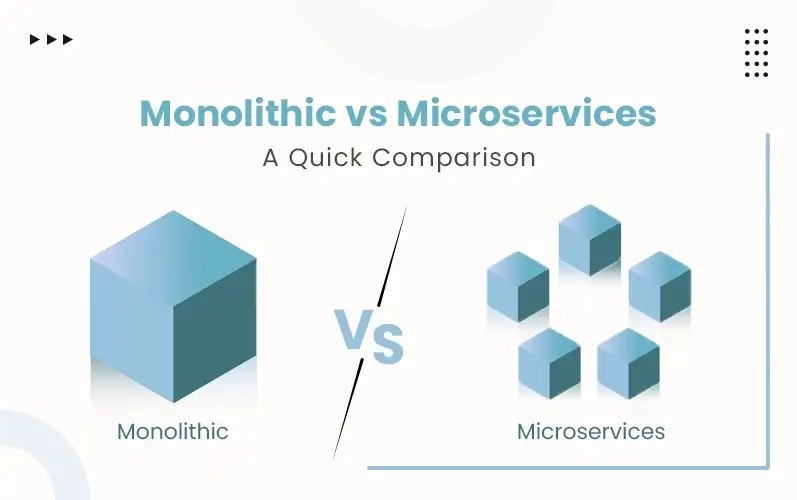
When businesses talk about software architecture, they’re really talking about different parts of the system that connect, communicate, and scale over time. It’s not just a technical decision. It shapes how fast your team can move, how easy the product is to maintain, and how painful (or painless) changes will be later. When choosing between software architectures, a business will have two choices:
- Monolithic architecture
- Microservices architecture
Selecting the right option according to your goal and requirement is crucial here. It will give a steady growth and keep both engineering and business teams aligned as the product evolves. On the flip side, the wrong choice can slow development, increase costs, or make scaling harder than it needs to be. So, how should you’re the right architecture for your business application? In this blog, we will discover it by understanding:
- The basics of monolithic architecture and microservices architecture
- The pros and cons of monolithic architecture vs microservices architecture
What is Monolithic Architecture?
A monolithic architecture is traditional application architecture. It is a single, unified approach where all parts are a connected system. Since it’s a monolithic system or a tightly contained unit, it needs to be changed entirely in case of any updates. This system has a very simple architecture that fits in small or mid-sized software systems. However, in case of any difficult needs, scaling such an architecture can be complex.
What are its Key Traits?
- Single codebase
All features are built and maintained in one place, which allows faster deployment initially.
- Tightly Contained Components
Different parts of the system depend on each other, so you can’t change or scale a specific part.
- One Large Deployment Unit
When you update or scale something, the entire application is deployed together.
When Is It Useful?
- Simple or Small Applications
A monolithic architecture system works well when for simple products. It suits mainly the software needs of small or mid-sized businesses.
- Faster Initial Development and Testing
With fewer or no independent parts, teams can build, test, and release features more quickly at an early stage.
What is Microservices Architecture?
A microservices architecture has a split-up architecture. To put it simply, it breaks an application into a set of small, self-contained services. Each service is responsible for one specific business function and communicates with other services through APIs or networks. Each part offers better scalability, flexibility, and agile process each time in case of feature updates. It’s a completely practical approach fit for modern problems oriented to software architecture.
What are the Key Traits of Microservices Architecture?
- Loosely coupled services
Each service runs on its own, so changes in one service are less likely to break others.
- Independent deployment and scaling
Teams can update or scale individual services without redeploying the entire application.
- Flexibility in technology choices
Different services can use different programming languages, databases, or tools, depending on what fits best.
- Work for Each Business Capabilities and Databases
Each microservice works around a specific business capability and has a separate database, making scaling the software more agile.
When is it useful?
- Microservices are often used when applications grow larger or more complex.
- Microservices architecture also matches the needs of enterprise-grade business applications.
Monolithic vs Microservices — Quick Comparison
Pros & Cons
Advantages of Monolithic
- Simpler to start with
Everything lives in one codebase, so teams don’t need to think about how services talk to each other.
- Easy to test and deploy
You test and release the entire application at once, instead of managing many small deployments.
- Lower initial development cost
Fewer tools, less infrastructure, and smaller teams are needed at the beginning.
- Easy deployment
One build produces one application, which makes release steps straightforward.
- Easy debugging and simple testing
Since all logic is in one place, tracing errors is faster, and issues are easier to reproduce.
Disadvantages of Monolithic
- Harder to scale with growth
You must scale the entire application even if only one feature needs more resources.
- Updates require a full redeploy
A small change still forces you to redeploy the whole system, increasing risk.
- It can become difficult to maintain over time
As the codebase grows, understanding and modifying it becomes harder.
- Not easy for technology adoption
Introducing new tools or languages affects the whole system and requires careful coordination.
- Problematic redeployment
Frequent deployments increase downtime risk as the application grows.
- Lack of flexibility
Changes in one area can impact unrelated parts of the system.
Advantages of Microservices
- Independent scaling & deployment
Each service can scale or deploy on its own without touching the rest of the system.
- Services can be developed by small teams
Teams can focus on one service and work autonomously without waiting for a long approval process.
- Technology flexibility
Each service can use the technology best suited for its function.
- Continuous deployment and integration
Updates can be released more frequently with less risk to the whole system.
- Easy testing, debugging, and maintenance
Issues are isolated to individual services, making fixes more targeted.
Disadvantages of Microservices
- Increased complexity and operational overhead
Managing many services requires more coordination, tooling, and planning.
- Debugging and monitoring take effort
Tracking issues across services is harder than in a single system.
- Need for strong DevOps support
You will have invest of hiring DevOps experts for automation, monitoring, and deployment pipelines are essential to keep things running smoothly.
- Lack of a standardised approach
Without clear rules, teams may build services differently, causing inconsistencies.
- Upgrading Server Support
DevOps relies on fast releases, but none of that works if servers are unstable. Hence, you will also have to upgrade or need better server management services.
Microservices vs Monolithic Architecture [ Advantages and Disadvantages for Businesses]
| Decision Factor | Monolithic Architecture | Microservices Architecture |
|---|---|---|
| Best for | Early-stage products, MVPs, small teams | Growing products, complex systems, larger enterprise-level teams |
| Time to market | Faster to launch initially | Slower at the start, faster over time |
| Initial cost | Lower upfront cost | Higher upfront investment |
| Ongoing cost | Increases as the system grows | More predictable with scale |
| Scaling approach | Scale the whole application | Scale only the needed services |
| Deployment impact | Full application redeploy required | Individual services deploy independently |
| Operational complexity | Low at the beginning | High without strong processes |
| Team structure | Works well with one team | Enables multiple small teams |
| Technology flexibility | Limited (one stack) | Flexible per service |
| Risk during updates | Higher risk with each release | Lower risk due to isolation |
| Maintenance over time | Becomes harder as codebase grows | Easier when services are well-defined |
| DevOps requirement | Basic setup is sufficient | Strong DevOps is essential |
When to Choose Each Architecture
Choose Monolithic Architecture When:
- Your project is for small and mid sized businesses
- The product has simple requirements
- You want to launch quickly with minimal setup
- You have a small team handling development
- Keeping initial costs low is a priority
Choose Microservices Architecture When:
- Your application is large or becoming complex
- You need high reliability and minimal downtime
- Multiple teams need to work independently
- Your business requires frequent updates
- Different parts of the system have different performance needs
Microservices often bring strong business advantages, such as:
- Cost-effective development at scaling since each component work independently
- High performance and speed, by scaling only what’s needed
- Better user experience, which can support higher conversion rates
- Flexibility to adopt new technologies for different services
- Faster technology adoption, without affecting the entire system
However, these benefits come with trade-offs:
- Microservices require a sophisticated, high-end setup
- Need to hire DevOps engineer due to strong DevOps, monitoring, and automation are essential
- Without the right foundation, complexity can outweigh the benefits
Used case
One of our enterprise-level eCommerce clients was operating on a large monolithic architecture that had supported the business for years. As the platform grew, more users, more products, more transactions—the system started showing clear limitations.
They were basically faced with the following problems:
- Performance slowed during high-traffic sales events
- Every update required a full system redeployment
- Scaling was getting complex as the entire application would need to update each of the features upon a feature upgrade. It was also hampering uptime.
- Introducing new technologies became risky and time-consuming.
Solution
We helped the client gradually transition from a monolithic setup to a microservices-based model. Key business functions like product catalog, checkout, payments, and order management were separated into independent services.
Outcome
- Checkout and search performance improved by around 30%
- High-traffic services scaled independently, reducing unnecessary infrastructure costs
- Deployment risks dropped significantly since updates no longer impacted the entire system
- The platform became more flexible for future growth and technology adoption
Conclusion
In simple terms, a monolithic architecture is a single, unified system that’s easier to build, deploy, and manage in the early stages, while a microservices architecture breaks an application into smaller, independent services that offer greater flexibility and scalability. Neither approach is “better” by default—the right choice depends on how complex your application is and how fast you expect it to grow. When deciding between the two, it’s important to consider your project size, business goals, budget, and team capabilities. Many teams start with a monolith to move quickly, then transition to microservices as performance needs, team size, and system complexity increase. The key is choosing an architecture that supports your business today without limiting where you want to go tomorrow.
What’s Next?
Do you need to transform the monolithic architecture into scalable microservices? The Tech Clouds is here to help. Book a free consultation call with our awesome DevOps Expert today!

Frequently Asked Questions
Can a company start with a monolithic architecture and move to microservices later?
Yes. Many companies do this. They start with a monolith to move fast and later split parts into microservices when the system becomes complex.
Is microservices architecture more expensive than monolithic?
Microservices usually cost more to run because they need more servers, tools, and monitoring. However, they can save money in the long run by scaling only what is needed.
Is monolithic architecture faster than microservices?
Monolithic applications are faster to build and deploy in the early stages. Microservices are better for handling high traffic and frequent updates over time.
What is the ideal architecture to start with: monolith or microservices?
For most new or small projects, monolithic architecture is the better starting point. Microservices make sense when the product grows and needs frequent changes or high reliability.
Do microservices require DevOps expertise?
Yes. Microservices need strong DevOps support to manage deployments, monitoring, and scaling. Without DevOps, microservices can become difficult to handle.
Which architecture should my business choose?
Choose monolithic architecture if your project is small and needs to launch quickly. Choose microservices if your business is growing, needs flexibility, and can support a more advanced setup.
Recent Posts






Related Blogs

How to Hire AWS Developers from India for Flexible Global Projects
More businesses are moving to cloud every year, and AWS is leading that shift. AWS now powers over 90% of Fortune 100 companies. 64% of all cloud users globally rely...
Common Cloud Migration Mistakes and How to Avoid Them
Businesses need fast, efficient, and secure systems in today's time. However, 70% face delays, cost overruns, or performance issues, even when cloud migration is done by experts. This is because...
Cloud Migration Checklist – An Ultimate Guide
Switching to the cloud is one of the most preferred choices of modern businesses. This strategy streamlines their workflow and provides flexibility and scalability. With a cloud computing strategy, remote...

Why Multi-Cloud Architecture Is Becoming Essential for Growing Businesses
Cloud computing has become an integral part of modern businesses. Companies are facing heavy pressures to stay adaptable, high-performing, and creative. Unlike traditional single-cloud or hybrid models, multi-cloud architecture delivers...
AWS vs Azure vs Google Cloud: Comparison Guide on Cloud Services
one of the options. But with its limited capability and availability, it can derail your work rhythm. This is where cloud computing services come to the rescue. According to a...

How to Detect and Stop a DDoS Attack for Businesses?
Distributed Denial of Service (DDoS) is the term that many people may encounter for the first time. This is a type of cyberattack. This disrupts server operations and workflows associated...

Cloud Migration: A Strategic Guide for Growing Business
Many startup owners often begin with a simple question: Why cloud migration? When you launch a business, its operations may seem manageable. But this won't remain the same after five...

Cloud Servers Explained: A Comprehensive Guide for 2026
Cloud server hosting continues to dominate business infrastructure strategies globally in 2026. Companies increasingly rely on cloud platforms to scale operations and improve flexibility. According to CloudZero, cloud spend under...